AI Did My Bookkeeping, But Who's Double-Checking the AI? (The Human-in-the-Loop You're Missing)
![[HERO] AI Did My Bookkeeping, But Who's Double-Checking the AI? (The Human-in-the-Loop You're Missing)](https://cdn.marblism.com/TLMWPLkYAKJ.webp "[HERO] AI Did My Bookkeeping, But Who's Double-Checking the AI? (The Human-in-the-Loop You're Missing)")
AI bookkeeping sounds like a dream come true, doesn't it? Upload your receipts, connect your bank accounts, and let the robots handle the rest while you focus on actually running your business.
But here's the uncomfortable truth: AI is only as smart as the data it's fed, and it doesn't know what it doesn't know.
When accounting automation tools miscategorize a $15,000 equipment purchase as "office supplies," nobody sends you an alert. When your AI software cheerfully files a client dinner under "meals and entertainment" instead of "marketing expenses" (costing you potential tax deductions), there's no flashing red light. The reports look clean. The numbers add up. Everything seems fine.
Until tax season hits. Or an investor asks for financials. Or you realize your profit margins are way off because half your transactions are in the wrong buckets.
So who's actually checking the AI's work? In most cases, nobody, and that's a problem.
The AI Bookkeeping Promise vs. Reality
Let's be clear: AI bookkeeping and automation tools have revolutionized how we handle financial data. They're fast, they can process thousands of transactions in seconds, and they're getting smarter every year.
Studies show that AI can detect up to 90% of accounting errors and spot fraud patterns that humans would miss buried in massive transaction volumes. That's impressive, and it's exactly why these tools have taken off.

But that remaining 10%? It's where things get messy. And for small businesses operating on thin margins, a 10% error rate isn't just inconvenient, it's potentially devastating.
The problem isn't that AI is bad at bookkeeping. It's that AI lacks context, judgment, and industry-specific knowledge that comes from actually understanding your business.
What AI Gets Wrong (More Often Than You'd Think)
Here are the most common ways AI bookkeeping goes off the rails:
Miscategorized transactions. Your AI sees "Amazon Business" and automatically files it under "office supplies." Sounds reasonable, right? Except that purchase was actually inventory for resale, which needs completely different tax treatment. The AI doesn't know the difference, it just sees the vendor name and makes an educated guess.
Missing strategic opportunities. AI might correctly categorize a business lunch, but it won't suggest that classifying it as a marketing expense (if you discussed partnerships or client work) could offer better tax advantages. It processes what it sees; it doesn't strategize what could be.
No understanding of unusual circumstances. You bought new laptops in January, then three more in March after a growth spurt. Your AI flags the second purchase as "suspicious duplicate" because the pattern doesn't match your historical spending. A human bookkeeper would check in and say, "Hey, I see you hired three people, makes sense!" AI just sees an anomaly.
Context-free compliance. Your software knows the general rules, but does it understand your state's specific sales tax exemptions? Does it know which expenses need supporting documentation beyond a credit card statement? Does it catch when vendor relationships might trigger 1099 requirements? Probably not.
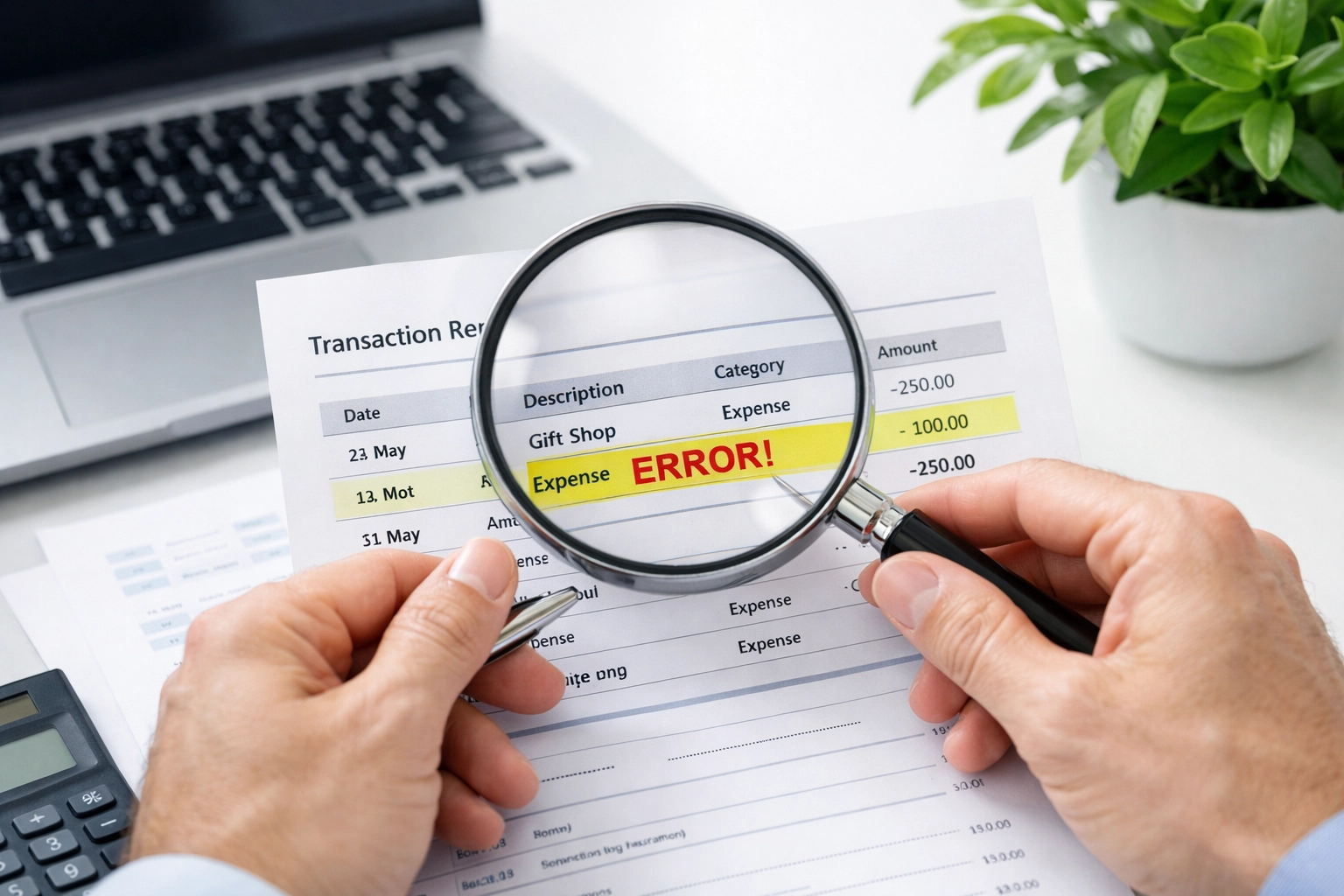
Duplicate invoice detection failures. This is a big one. You might receive an invoice via email, then get a paper copy, then have it entered in your payment system. AI might catch two of them... or it might process all three because they have slightly different file names or date stamps.
How to Automate Bookkeeping Without Losing Control
Here's the good news: you don't have to choose between automation and accuracy. The winning approach is a hybrid model where AI handles the heavy lifting, but humans maintain strategic oversight.
Think of it like self-driving cars with a driver in the seat. The automation does 90% of the work, but someone's there to take the wheel when conditions get tricky.
The key is establishing tiered approval workflows based on transaction risk. For example:
Transactions under $100 from known vendors? Auto-process.
Transactions between $100-$1,000? Flag for quick review.
Anything over $1,000 or from a new payee? Requires manual approval.
Your thresholds might look different depending on your business size and risk tolerance, but the principle remains: automation with guardrails.
When AI flags something as anomalous, unusual vendor relationships, spending spikes, duplicate possibilities, that's when human eyes need to investigate before anything gets finalized in your books.

Why "Set It and Forget It" Doesn't Work
The biggest mistake small business owners make with AI bookkeeping is treating it like a Crockpot. You can't just dump everything in, turn it on, and walk away for six months.
Your books need ongoing attention because:
Your business changes (new products, new vendors, new tax situations)
Tax laws change (hello, annual updates)
Banking connections break (yes, even with "automatic" syncing)
Historical patterns shift (seasonal businesses especially)
Without human oversight, these changes don't get caught until they've already caused problems.
The BookkeeWhat Human Oversight Actually Catches
Professional bookkeepers don't just check AI's math, they catch the stuff that algorithms miss entirely:
Strategic tax positioning. A bookkeeper familiar with your business knows when to push for clearer documentation, when expenses can be allocated differently for tax advantages, and which deductions you're leaving on the table.
Industry-specific quirks. If you're in construction, your bookkeeper knows about retention, progress billing, and job costing. If you're in e-commerce, they understand marketplace fees, chargebacks, and inventory accounting methods. AI doesn't have that specialized knowledge.
Relationship context. Your bookkeeper knows that "irregular" payment to your seasonal contractor isn't fraud, it's just how your industry works. They understand the story behind the numbers.
Compliance requirements. While accounting automation tools can apply general rules, humans ensure you're meeting IRS requirements, following GAAP principles, and satisfying any industry-specific regulations. This is especially critical because you remain personally responsible for compliance, even when using automation.
The Documentation Feedback Loop You're Probably Missing
Here's what most businesses don't do (but should): document every AI error and override.
When your team spots something the AI got wrong, recording what happened and why creates a feedback loop that improves your system over time. Was it an unusual transaction type? A new vendor? An industry-specific categorization the AI doesn't understand?
This documentation serves two purposes:
It helps refine your AI parameters and approval thresholds
It creates an audit trail showing you're actively monitoring your books
If you're spending the same amount of time reviewing AI-processed bookkeeping as you did manually processing everything, something's wrong. Either your approval workflows are too conservative, or your system needs better training.

ping Made Simple Approach
At Bookkeeping Made Simple, we use a human-in-the-loop model that gives you the best of both worlds: the efficiency of automation with the accuracy and strategic insight of experienced bookkeepers.
We leverage accounting automation tools to handle the routine stuff: transaction imports, basic categorization, bank reconciliations. But every account gets regular human review to catch what the AI misses, identify opportunities, and ensure compliance.
We build customized approval workflows based on your business size, industry, and risk tolerance. We document overrides and refine the process continuously. And we provide the strategic financial insights that AI simply can't offer: like cash flow forecasting, tax planning recommendations, and growth-oriented financial analysis.
Think of it as having a professional double-check everything before it becomes permanent in your books. Because the time to catch a bookkeeping error isn't during an IRS audit or when you're trying to secure business funding: it's right now, before it compounds.
The Bottom Line
AI bookkeeping isn't bad: it's just incomplete. Accounting automation tools can handle volume and speed far better than any human, but they lack the judgment, context, and strategic thinking that turns raw financial data into actionable business intelligence.
The question isn't whether to use automation. It's who's making sure the automation is actually working correctly.
If you're relying solely on AI without professional oversight, you're essentially hoping that nothing unusual happens in your business: and hoping isn't a great financial strategy.
Want to see how much more accurate (and insightful) your books could be with human-in-the-loop oversight? Let's talk about what our bookkeeping services could look like for your business. Because your financial data is too important to trust to robots alone.