What Is a Break-Even Point for a Small Business?
What Is a Break-Even Point for a Small Business?
Revenue is growing. Customers are buying. Money is moving through the business.
But is the business actually covering its costs?
That is the question a break-even analysis is designed to answer.
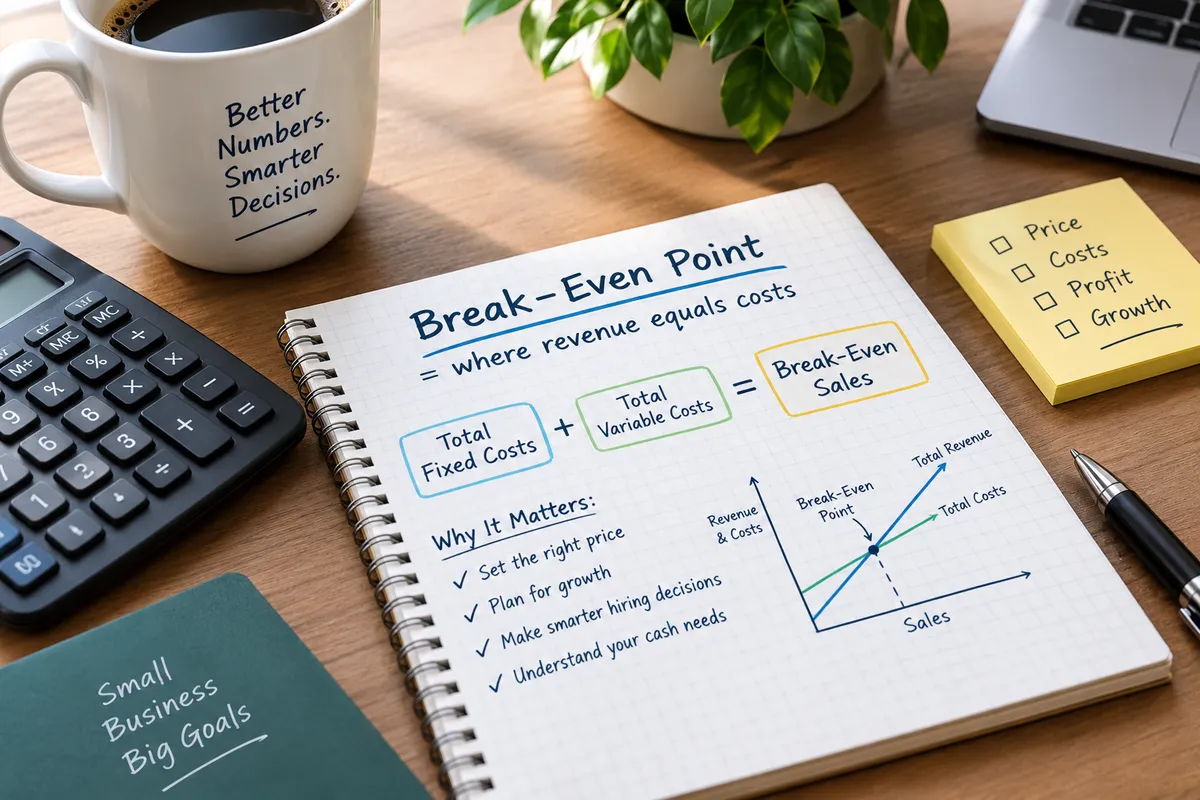
Your break-even point is the level of sales your business needs to cover its costs without producing either a profit or a loss.
Understanding that number can help a small business owner make better decisions about pricing, expenses, hiring, sales goals, and growth.
It does not tell you everything about the financial health of a business, but it gives you a useful line in the sand: the point where the business moves from covering its costs to generating profit.
What Does Break-Even Mean in Business?
A business reaches break-even when its revenue is enough to cover the costs included in the analysis.
Below that point, the business is operating at a loss.
Above that point, additional sales can begin contributing toward profit, assuming the underlying costs and pricing remain reasonably consistent.
For example, suppose a business needs $40,000 in monthly sales to cover its fixed and variable costs.
If it generates $35,000, it has not yet reached break-even.
If it generates $40,000, it is approximately at break-even.
If it generates $50,000, it has moved beyond the break-even point and may be generating a profit.
That makes break-even analysis useful because it turns a vague goal such as "we need more sales" into a more specific financial question.
Why Should a Small Business Know Its Break-Even Point?
Knowing your break-even point gives context to your revenue.
A business owner may be excited about reaching $500,000 in annual sales.
But if the business needs $490,000 in sales just to cover its costs, that revenue tells a very different story than it would for a company that breaks even at $300,000.
Break-even analysis can help with questions such as:
How much revenue do we need each month?
Are our prices high enough to support our costs?
Can we afford another recurring expense?
How much additional business would we need to support a new employee?
What happens if our costs increase?
How far above break-even are we currently operating?
How much room do we have if sales slow down?
Those are business-management questions, not just accounting questions.
What Costs Are Used in a Break-Even Analysis?
To understand break-even, it helps to separate costs into two broad groups.
Fixed Costs
Fixed costs generally do not change directly with every additional sale in the short term.
Examples might include:
Rent
Certain software subscriptions
Insurance
Administrative salaries
Professional services
Some recurring overhead expenses
A business generally needs to cover these costs whether it makes one sale or one hundred.
Variable Costs
Variable costs tend to increase as the business sells more products or delivers more services.
Depending on the business, these might include:
Materials
Product costs
Shipping
Direct labor
Sales commissions
Certain transaction fees
Other costs directly tied to delivering the sale
The distinction matters because each sale does not contribute its entire selling price toward covering fixed costs.
Some portion of the sale may first be needed to cover the variable cost of delivering it.
What Is Contribution Margin?
Contribution margin is an important part of break-even analysis.
It represents the amount from a sale that remains after the variable costs associated with that sale are deducted.
For example:
A business sells a service for $500.
The variable costs directly associated with delivering that service are $200.
The contribution margin is:
$500 - $200 = $300
That $300 can then contribute toward covering the business's fixed costs.
Once fixed costs are covered, additional contribution margin can begin contributing toward profit.
Contribution margin is related to gross margin, but the exact classification of costs can differ depending on the business and the purpose of the analysis.
If you want a deeper explanation of margins, read What Is Gross Margin and Why Does It Matter More Than Revenue?.
How Do You Calculate a Break-Even Point?
For a business that sells a clearly defined product or service unit, a basic formula is:
Break-even units = Fixed costs ÷ Contribution margin per unit
Suppose a business has:
$12,000 in monthly fixed costs
A selling price of $500 per service
$200 in variable costs per service
The contribution margin per service is:
$500 - $200 = $300
The break-even calculation would be:
$12,000 ÷ $300 = 40
The business would need to sell approximately 40 services per month to cover the costs included in the calculation.
Sales beyond that point can begin contributing toward profit.
What If Your Business Doesn't Sell Simple Units?
Many service businesses do not sell identical products at identical prices.
A consulting firm, contractor, professional service company, or agency may have multiple services, customers, prices, and delivery costs.
In those situations, it may be more useful to think about break-even in terms of sales revenue rather than the number of units sold.
A business can use its contribution margin ratio to estimate the level of revenue needed to cover fixed costs.
The concept remains the same:
How much business must we generate before the amount remaining after variable costs is enough to cover our fixed costs?
The actual analysis may need to be adjusted for the way your business operates.
Break-Even Point vs. Profit Goal
Break-even should not be confused with a profit target.
Breaking even means you have covered the costs included in your analysis.
That is not necessarily where you want the business to stay.
A business still needs profit to build reserves, reinvest, support growth, compensate owners appropriately, and provide financial flexibility.
So instead of asking only:
"What do we need to sell to break even?"
A stronger planning question is:
"What do we need to sell to cover our costs and reach the level of profit we actually want?"
Your break-even point can serve as the baseline.
Your profit goal sits above it.
How Break-Even Analysis Can Help With Pricing
Pricing changes can have a significant impact on break-even.
Imagine your prices remain the same while labor, materials, software, or other delivery costs increase.
Your contribution margin may shrink.
When that happens, the business may need to sell more just to reach the same break-even point.
That is one reason rising revenue does not automatically mean financial performance is improving.
If costs are rising faster than prices, the business may be working harder without keeping more of what it earns.
Break-even analysis can provide another way to evaluate whether current pricing is supporting the financial needs of the business.
How Break-Even Analysis Can Help With Hiring
Hiring usually increases recurring costs.
Before adding an employee, you can update the break-even calculation to see how the new expense changes the level of sales the business needs to support.
For example, if adding a position increases monthly costs by several thousand dollars, the business can estimate how much additional contribution margin will be needed to cover that expense.
That does not mean the employee must personally generate that amount of revenue.
A new hire may create value by increasing capacity, improving operations, freeing the owner to sell, or allowing the business to serve more customers.
But understanding how the hire changes the break-even point gives the owner another piece of information for making the decision.
How Break-Even Analysis Can Help With Expansion
The same idea applies to expansion.
Suppose a business is considering:
A larger office
New equipment
Another location
Additional software
More employees
A new product or service
Each decision may change the cost structure.
Before committing, ask:
How will this change our break-even point?
If the investment significantly increases fixed costs, the business may need considerably more revenue before it becomes financially worthwhile.
A forecast can then help the owner compare the higher cost structure with expected future sales.
Break-Even Is Not the Same as Cash Flow
A business can be above its accounting break-even point and still experience cash flow pressure.
Why?
Because timing matters.
Customers may not have paid invoices yet.
Loan payments may be due.
Taxes may need to be paid.
A large purchase may require cash.
Accounts payable may be coming due before accounts receivable is collected.
That is why break-even analysis should be used alongside cash flow information rather than as a replacement for it.
Accurate monthly bookkeeping helps provide the financial records needed to understand revenue, expenses, receivables, payables, and financial performance.
Common Break-Even Mistakes
Break-even analysis is useful, but it becomes less useful when the underlying numbers are inaccurate.
Using Outdated Costs
If labor, materials, software, rent, or other expenses have changed, an old break-even calculation may no longer reflect the business.
Forgetting Variable Costs
Looking only at fixed expenses can make the required sales level appear lower than it really is.
Treating Every Sale as Equally Profitable
Businesses with multiple products or services may have very different margins across their offerings.
Selling $10,000 of one service may contribute much more toward fixed costs than $10,000 of another.
Ignoring Cash Flow
Break-even answers a profitability-related question.
It does not tell you exactly when cash will enter or leave the bank account.
Assuming the Calculation Never Changes
Your break-even point can move when pricing, costs, staffing, product mix, or operating structure changes.
It should be revisited when the business changes materially.
How Often Should You Review Your Break-Even Point?
There is no universal schedule that fits every small business.
However, it makes sense to revisit the calculation when important financial conditions change.
Examples include:
Prices change
Labor costs change
Vendor costs rise
The business hires employees
A new location is added
A major recurring expense is added
Profit margins change
The business launches a new service
Revenue changes significantly
Even when nothing dramatic happens, periodically reviewing the underlying numbers can help confirm that the assumptions still make sense.
What If Your Break-Even Point Seems Too High?
A high break-even point is not automatically bad.
Some businesses naturally have higher fixed costs than others.
The useful question is whether the business's sales, margins, and operating structure can reasonably support that level.
If the break-even point feels difficult to reach, there are several areas to examine:
Pricing
Direct costs
Fixed overhead
Product or service mix
Operational efficiency
Sales volume
Profit margins
The answer is not always "sell more."
Sometimes the better financial decision is to improve margins, reduce an unnecessary expense, change pricing, or reconsider how a service is delivered.
Bookkeeping Provides the Data. Advisory Helps You Use It.
A break-even analysis depends on having reliable information about your revenue and costs.
If the underlying bookkeeping is incomplete or inaccurate, the calculation may be misleading.
That is where ongoing bookkeeping provides the foundation.
For business owners who want to go further and use that information to evaluate pricing, profitability, hiring, expansion, forecasting, and growth, Business Advisory & Fractional CFO support can help turn financial reports into more practical decision-making tools.
Bookkeeping Made Simple provides business advisory and fractional CFO support specifically around areas including cash flow, pricing, profitability, hiring, expansion, and forecasting. My Simple Bookkeeping
Frequently Asked Questions
What is a break-even point?
A break-even point is the level of sales at which the revenue generated is enough to cover the costs included in the analysis, resulting in neither a profit nor a loss.
How do you calculate break-even for a small business?
A common unit-based formula is fixed costs divided by contribution margin per unit. Businesses with multiple products or services may instead evaluate break-even based on sales revenue and contribution margin ratios.
Is break-even the same as profitability?
No. Break-even is the point where the business covers the costs included in the analysis. Profitability begins above the break-even point.
Does break-even include the owner's pay?
It depends on how the business is structured and what costs are included in the analysis. The important thing is to define the assumptions clearly so the calculation reflects the decision you are trying to make.
Can my business be above break-even and still have cash flow problems?
Yes. Break-even and cash flow measure different things. A business may be profitable while still waiting for customer payments or facing significant upcoming cash obligations.
Know the Number Behind Your Sales Goal
Revenue goals are more useful when they are connected to the financial structure of the business.
Knowing your break-even point can help you understand how much business is required to cover costs and what needs to happen before additional sales begin contributing toward profit.
It can also make decisions about pricing, hiring, spending, and expansion easier to evaluate.
Bookkeeping Made Simple provides ongoing bookkeeping and Business Advisory & Fractional CFO support to small business owners who want reliable financial information and help understanding what those numbers mean for their business.
Schedule Your Free Financial Clarity Call