Close Your Books in 7 Days: The Stress-Free Guide to Faster Financial Insights
![[HERO] Close Your Books in 7 Days: The Stress-Free Guide to Faster Financial Insights](https://cdn.marblism.com/P5PWvwWA5Ib.webp "[HERO] Close Your Books in 7 Days: The Stress-Free Guide to Faster Financial Insights")
Let's be honest: Making business decisions based on 20-day-old financial data is like driving a car while staring in the rearview mirror. Sure, you can technically do it, but you're probably going to hit something.
If you're still waiting until the 15th, 20th, or (gulp) end of the month to close your books, you're not alone. Most small business owners are stuck in this cycle. But here's the thing, by the time you finally see last month's numbers, you've already made dozens of decisions without them. That's not strategy. That's guesswork.
The good news? You can close your books in 7 days or less. And no, you don't need a finance degree or a team of accountants to pull it off. You just need the right system, a few smart habits, and maybe a little help from the pros (hint, hint).
Let's break down exactly how to make it happen.
Why the 7-Day Close Matters
When it comes to bookkeeping for small business, speed isn't just a nice-to-have, it's a competitive advantage. Think about it: If you close your books on February 7th instead of February 25th, you're making March decisions with actual data instead of gut feelings.

That means:
You know if you can afford that new hire
You spot cash flow problems before they become emergencies
You can adjust pricing, marketing spend, or inventory orders while there's still time to course-correct
Financial reporting for small business isn't just about compliance or tax prep. It's about having a crystal-clear picture of where your money went and where it's going next. And the faster you get that picture, the better decisions you make.
The Foundation: Your Month End Close Checklist
Here's the truth bomb: You can't close fast if you don't know what you're closing. That's where a solid month end close checklist comes in.
Your checklist should include:
Daily Tasks (Yes, Daily)
Reconcile yesterday's transactions (bank accounts, credit cards)
Log receipts and expenses as they happen
Review outstanding invoices and follow up on payments
Weekly Tasks
Run a quick profit & loss report to spot any oddball entries
Check your accounts receivable aging report
Categorize any "mystery" transactions before they pile up
Month-End Tasks (Days 1-7)
Final bank and credit card reconciliations
Review balance sheet for accuracy
Close out payroll and contractor payments
Run depreciation and amortization (if applicable)
Generate final financial statements
Review reports with your bookkeeper or accountant
Notice something? Most of the heavy lifting happens before the month ends. That's the secret. If you're scrambling on Day 1 of the new month to categorize three weeks' worth of receipts, you're already behind.
The Game-Changer: Accounting Automation
Let's talk about the elephant in the room: manual data entry is killing your timeline.
If you're still downloading bank statements, typing numbers into spreadsheets, or hunting for crumpled receipts in your glove compartment, you're wasting hours. Accounting automation is the difference between closing on Day 7 and closing on Day Never.
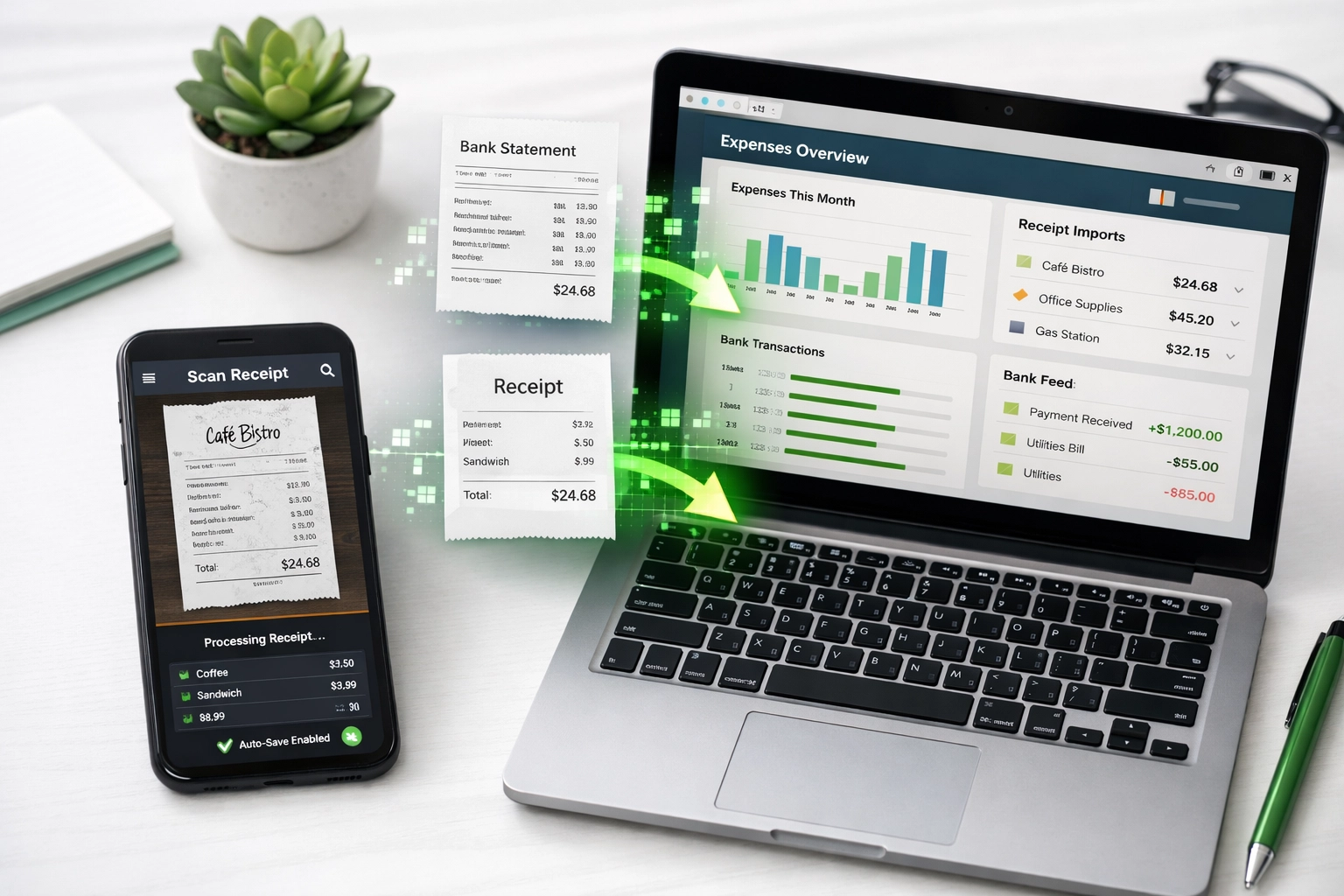
Here's what automation looks like in practice:
Connected Bank Feeds
Your accounting software syncs directly with your bank and credit card accounts. Transactions flow in automatically. No data entry. No typos. No "oops, I forgot about that subscription charge."
Receipt Capture Apps
Snap a photo of your receipt with your phone, and the app extracts the vendor, amount, and date. It even suggests the right category. Then it files the digital copy so you're never digging through shoeboxes during tax season.
Automated Invoice Reminders
Your software sends gentle (or not-so-gentle) reminders to clients who haven't paid yet. You get paid faster. Your cash flow improves. And you don't have to be the "bad guy" chasing down invoices.
Pre-Set Categorization Rules
Once you tell the system that "Joe's Coffee Shop" is always a "Meals & Entertainment" expense, it remembers. Forever. No more categorizing the same vendor 47 times.
The result? Tasks that used to take hours now take minutes. And that's how you shave weeks off your close timeline.
Small Business Accounting Tips That Actually Work
Beyond automation, there are a few old-school habits that make a massive difference. These small business accounting tips might sound basic, but they're the foundation of a fast close:
1. Separate Business and Personal Finances
If you're still using your personal checking account for business expenses (or vice versa), stop. Right now. This is the #1 way to create a tangled mess that takes days to sort out at month-end. Get a dedicated business account and a business credit card. Your future self will thank you.
2. Update Bank Feeds Daily (or at Least Weekly)
I know, I know. Daily reconciliation sounds like overkill. But here's the deal: If you wait until the end of the month, you'll have 30+ days of transactions to sort through. Errors compound. Mystery charges multiply. By the time you're done, it's Day 18.
But if you add transactions daily? It takes 5 minutes. You catch errors immediately. And when month-end rolls around, you're basically already done.
3. Set Deadlines for Your Team
If you have employees or contractors submitting expense reports or timesheets, give them a hard deadline. "All expense reports due by the 2nd of the month" is non-negotiable. Otherwise, you're waiting on stragglers until Day 15.

4. Review Reports While They're Fresh
Don't just generate reports and file them away. Actually look at them. Compare this month to last month. Spot trends. Ask questions like, "Why did our software expenses jump 40%?" or "Where did that $1,200 'Miscellaneous' charge come from?"
The whole point of financial reporting for small business is to give you actionable insights. But insights are only useful if you, you know, use them.
The 7-Day Close Roadmap
Okay, let's put it all together. Here's your step-by-step game plan for closing your books in 7 days:
Day 1 (The 1st of the Month):
Run your final bank reconciliations for the previous month
Ensure all transactions are categorized
Check for duplicate entries or obvious errors
Day 2:
Reconcile credit cards and any other payment accounts (PayPal, Stripe, etc.)
Review and finalize payroll entries
Log any outstanding bills or invoices that came in late
Day 3:
Run your balance sheet and profit & loss reports
Compare to previous months: do the numbers make sense?
Flag anything that looks off and investigate
Day 4:
Make any necessary adjusting entries (depreciation, accruals, prepaid expenses)
Double-check your accounts receivable and accounts payable aging reports
Follow up on any missing documentation
Day 5:
Generate final financial statements
Review key metrics (gross margin, net profit, cash flow)
Prepare any management reports or dashboards
Day 6:
Have a quick sync with your bookkeeper or accountant (if applicable)
Finalize any last-minute adjustments
Lock down the period so no one can sneak in retroactive changes
Day 7:
One final review to make sure everything's buttoned up
Distribute reports to stakeholders (yourself, partners, investors)
Pop the champagne (or at least the sparkling water)

When DIY Isn't Cutting It
Here's the reality check: Even with automation and a killer checklist, closing your books in 7 days takes time and expertise. If you're a business owner who's already wearing 17 different hats, adding "bookkeeper extraordinaire" to the list might not be realistic.
That's where partnering with a professional bookkeeping service makes sense. At Bookkeeping Made Simple, we handle all the heavy lifting: reconciliations, categorization, report generation: so you get clean, accurate financials by Day 7 every single month. You just get to make smarter decisions with them.
We use the latest accounting automation tools, follow a proven month-end close process, and actually explain what your numbers mean (no jargon, no judgy accountant vibes). It's like having an in-house finance team without the overhead.
The Bottom Line
Closing your books in 7 days isn't some mythical unicorn goal. It's totally doable with the right systems, a bit of discipline, and a little help when you need it.
Stop driving your business by looking in the rearview mirror. Get your financial data while it's fresh, make decisions with confidence, and watch what happens when you finally know where your money's actually going.
Need help getting there? We've got you. Let's talk.