How Much Should a Small Business Set Aside for Taxes?
How Much Should a Small Business Set Aside for Taxes?

If you’ve ever reached the end of a record-breaking month, looked at your bank balance, and felt like a financial wizard: only to realize that a chunk of that money belongs to Uncle Sam: welcome to the club. It’s the "entrepreneurial hangover," and the only cure is a solid tax-savings strategy.
Most small business owners treat tax savings like a game of Pin the Tail on the Donkey. They guess a number, hope for the best, and usually end up either panicking in April or accidentally overpaying throughout the year.
At Bookkeeping Made Simple, we see this all the time. The question isn't just "how much do I owe?" it’s "how do I stop worrying about it?" Today, I’m breaking down the formula that actually works, why the "standard" advice is often wrong, and how to stay ahead of the game without losing your mind.
The Mistake Most Business Owners Make
The biggest mistake? Thinking that your personal income tax bracket is the only thing that matters.
When you were an employee, your employer handled the "invisible" taxes. You saw your gross pay, saw a deduction for Federal Income Tax, and went about your day. But as a business owner, you are both the employer and the employee. This means you’re now responsible for the full weight of the tax burden: and there’s a specific line item that catches most people off guard: Self-Employment Tax.
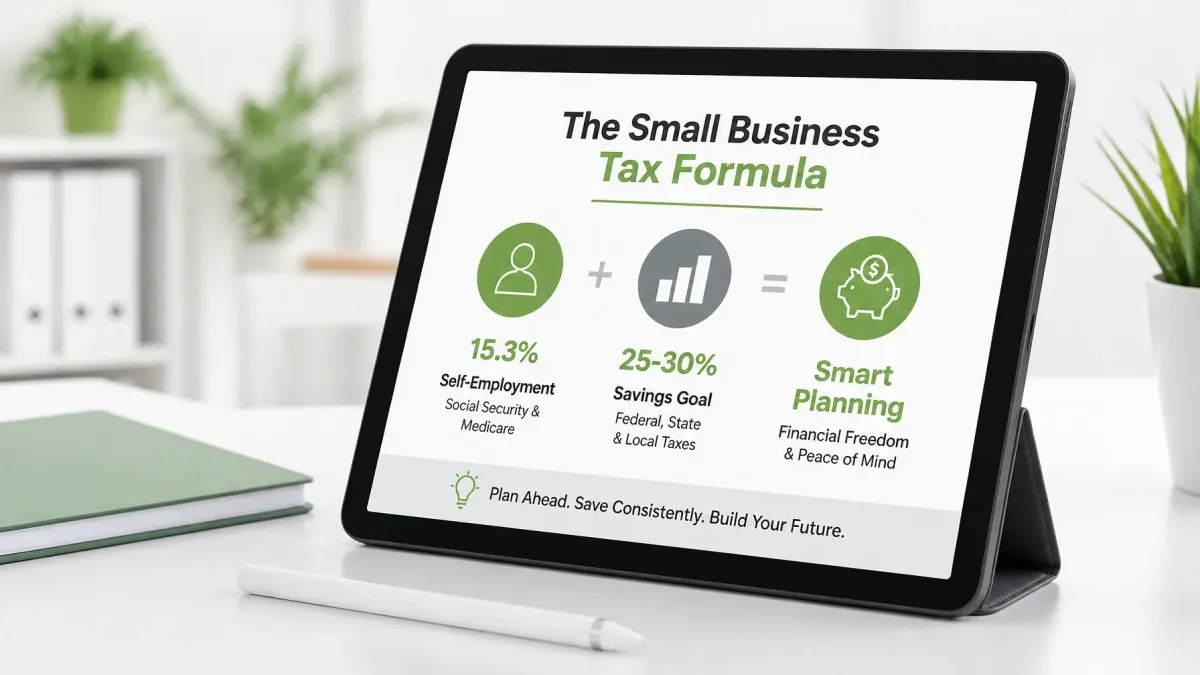
The "Hidden" 15.3%: Self-Employment Tax Explained
Before we even talk about income tax, we have to talk about Self-Employment (SE) tax. This is essentially the Social Security and Medicare tax that would normally be split between an employer and an employee.
In the corporate world:
You paid: 7.65%
Your boss paid: 7.65%
In the small business world:
You pay: All 15.3%.
Ouch. This tax applies to your net earnings (profit), not just what you "pay yourself" (unless you’re an S-Corp, but that’s a whole other conversation). Generally, you pay this 15.3% on about 92.35% of your net business profit.

The Income Tax Layer: Why Your Bracket Matters
Once the SE tax is accounted for, we have to layer on the Federal Income Tax. This is where it gets personalized. Depending on your total income, filing status, and deductions, you could be in the 10%, 12%, 22%, or higher bracket.
If you’re in the 22% bracket, it doesn’t mean you pay 22% on everything. It’s a progressive system. However, when you combine your marginal income tax rate with that 15.3% SE tax, you can quickly see why a "10% savings plan" will leave you in a very deep hole.
The "Safety Net" Rule: The 25-30% Strategy
If you want a "set it and forget it" number, the golden rule for most small businesses is to set aside 25% to 30% of your net profit.
Why this range?
25% usually covers SE tax and a lower income tax bracket.
30% provides a cushion for state taxes or higher earnings.
If you live in a state with high income tax (looking at you, California and New York), you might even want to bump that to 35%.
Is it painful to see 30% of your hard-earned cash sit in a separate "Don't Touch This" savings account? Yes. Is it more painful to owe $15,000 on April 14th with $200 in the bank? Also yes.

The Formula That Actually Works
If "guessing 30%" isn't precise enough for you, here is the formula we use to help our clients find their "True Tax Number":
Calculate Net Profit: (Gross Revenue - Business Expenses).
Estimate SE Tax: Net Profit x 0.9235 x 0.153.
Estimate Income Tax: (Net Profit - 1/2 of SE Tax) x Your Marginal Tax Rate.
Add them together: This is your total estimated federal tax.
Pro-Tip: Take that total number, divide it by your total revenue, and you’ll get a "Tax Percentage" unique to your business. For example, if you find out you need to save 22 cents of every dollar that comes in, you can automate that transfer every single Friday.
Quarterly Estimated Payments: Don’t Give the IRS a Reason to Grumble
The IRS is like that one friend who hates waiting for their money. If you expect to owe more than $1,000 in taxes for the year, they require you to pay in installments. These are called Quarterly Estimated Tax Payments.
For 2026, the typical deadlines are:
Q1: April 15
Q2: June 15
Q3: September 15
Q4: January 15 (of the following year)
If you ignore these, the IRS may slap you with underpayment penalties. To avoid this, use the Safe Harbor Rule: If you pay at least 100% of the tax you owed last year (or 90% of what you’ll owe this year), you generally won't face penalties, even if you still owe a balance in April.

Why Clean Books Make Everything Easier
You can’t calculate 30% of "I think I made some money."
This is where many business owners hit a wall. If your personal and business expenses are a tangled web of Amazon receipts and "was that lunch a client meeting or a date?", you can’t accurately calculate your net profit. And if you don't know your profit, you don't know your tax.
Clean, real-time bookkeeping does three things for your tax strategy:
Accuracy: You save exactly what you need: no more, no less.
Deduction Discovery: We find the expenses you forgot about, which lowers your profit and, by extension, your tax bill.
Confidence: When your books are up-to-date 24/7, you can check your "Tax Due" estimate any day of the week.
At Bookkeeping Made Simple, we don't just crunch the numbers; we give you the insights to know exactly where you stand. We handle the stress-free bookkeeping so you can focus on the growth that creates the tax bill in the first place!
Final Thoughts: Treat Your Tax Account Like a Bill
The best advice I can give is to treat your tax savings account like any other mandatory bill: like rent or payroll. It isn't "your" money; it's just passing through your hands on its way to the treasury.
By setting aside 25-30% consistently and staying on top of your bookkeeping, you turn "Tax Season" into just another Tuesday.
Ready to stop guessing and start knowing? Reach out to us today for a consultation. Let’s get your books in order so you can stop worrying about the IRS and start focusing on your legacy.