Is Your Bookkeeping Ready for Tax Planning? 7 Things to Review Before April
![[HERO] Is Your Bookkeeping Ready for Tax Planning? 7 Things to Review Before April](https://cdn.marblism.com/TIPNYzqp8Gn.webp "[HERO] Is Your Bookkeeping Ready for Tax Planning? 7 Things to Review Before April")
You know that awkward moment when your CPA opens your books and lets out a long, tired sigh? That sound is the prelude to what I call the "organized mess fee", the extra hours they'll charge to untangle your financial records before they can even start on your actual tax return.
Here's the thing: tax preparation for small business doesn't have to be stressful or expensive. The difference between a smooth tax season and a chaotic one comes down to what you do right now, in February and March, before the April 15th deadline arrives.
Clean, organized books aren't just about impressing your accountant (though that's a nice bonus). They're about saving money, reducing stress, and making sure you're not leaving deductions on the table because your records are too messy to trust.
Let's walk through the seven critical areas you need to review to ensure your bookkeeping for taxes is actually working for you, not against you.
1. Reconcile and Close Out Your Prior Year Books
This is your foundation. If your 2025 transactions are still floating around in limbo, half-categorized, partially reconciled, or just plain missing, everything else on this list is pointless.
Here's what "closing out" actually means:
Every transaction from January 1, 2025, through December 31, 2025, is recorded
All accounts (checking, savings, credit cards, loans) are reconciled to their December 31st statements
There are no mystery transactions sitting in "uncategorized" or "ask my accountant"
Your balance sheet actually balances
Think of this like trying to build a house on a cracked foundation. Your CPA can't give you solid tax planning for small business advice if they're not sure whether your books are complete or accurate. And you definitely can't make strategic decisions about next year if you don't have a clear picture of last year.

2. Hunt Down All Your Tax Documents
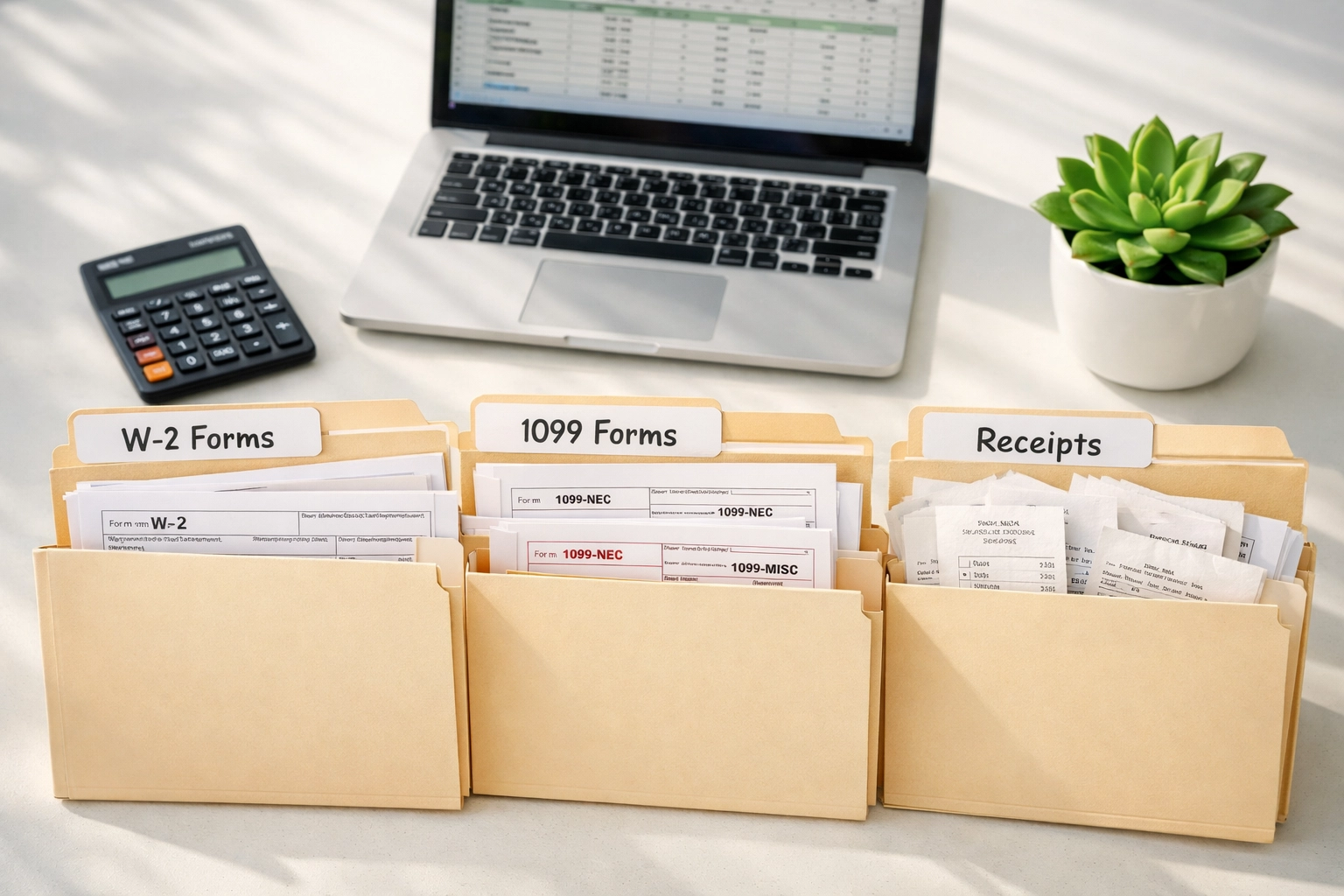
February is prime 1099 and W-2 season. These documents are trickling in from clients, payment processors, banks, and anyone else who paid you or sent you money last year.
Create a simple tracking system:
List every client or platform that should send you a 1099
Check off each one as it arrives
Follow up on any missing documents by mid-February
Keep digital and physical copies organized in one place
The IRS gets copies of these same documents. If your tax return shows different numbers than what they received, you're asking for a closer look, and nobody wants that kind of attention.
Missing a 1099? Don't just hope it'll show up. Contact the issuer now while there's still time to get a duplicate or at least confirm the numbers so your CPA can report the income accurately.
3. Double-Check Your Revenue and Expense Categories
This is where most small business owners hemorrhage money without realizing it. Every transaction that's miscategorized is either:
A deduction you're missing out on
An expense inflating the wrong category (making your financials look weird)
A red flag that could trigger questions during an audit
Common categorization mistakes:
Personal expenses mixed with business (huge no-no)
Office supplies recorded as equipment (different tax treatment)
Meals categorized as entertainment (different deduction rules)
Subcontractor payments filed under general expenses instead of contractor services
Your small business accounting tips don't get more practical than this: spend an hour reviewing your Profit & Loss report. If you see a category that's way higher or lower than expected, drill down and check the individual transactions. You'll almost always find something that's in the wrong bucket.
4. Reconcile Every Bank and Credit Card Account
I know, I know, you already did this in step one, right? Not quite. That was your year-end reconciliation. This is your sanity check.
Go through each month of 2025 and make sure:
Your accounting software matches your bank statements
There are no duplicate transactions
No transactions are mysteriously missing
The ending balance in your books matches the ending balance on your statement
Why this matters for tax preparation: Your CPA is going to ask for bank statements. If your books don't match those statements, they'll either spend billable hours fixing it (hello, organized mess fee) or they'll ask you to fix it and delay your filing.
Neither option is fun. Get ahead of it now.
5. Organize Documentation for Every Major Deduction
The IRS isn't impressed by your word. They want receipts, invoices, mileage logs, and paper trails. If you're claiming a deduction, you need documentation to back it up.
Create digital folders for:
Major equipment or asset purchases
Business mileage logs (if you deduct vehicle expenses)
Home office expenses (if applicable)
Travel and meal receipts
Charitable contributions
Professional development and courses
Subscriptions and software
This isn't just about avoiding problems. It's about confidence. When your CPA asks, "Can you substantiate this deduction?" you want to immediately say yes and provide the backup. That confidence translates into a faster, cheaper, and less stressful tax filing experience.

6. Review Income from All Sources
If you're self-employed or have multiple income streams, this gets complicated fast. You might have:
1099-NEC forms from clients
1099-K forms from payment platforms like PayPal or Stripe
Direct deposits from customers
Cash or check payments
Barter or trade income (yes, that counts)
The goal is to make sure every dollar that came into your business is accounted for. Because again, the IRS is getting copies of those 1099s. If your tax return shows $75,000 in income but your 1099s add up to $82,000, you've got a problem.
Pro tip: If you use payment processors, watch out for the 1099-K. It reports gross transactions, including fees and refunds. Your actual income is net of those items. Your CPA needs to know how to reconcile that difference, and clean books make that process infinitely easier.
7. Evaluate Your Business Structure for Tax Optimization
This is the sneaky-important one that most people skip. Your business structure: sole proprietorship, LLC, S-Corp, partnership: has massive tax implications. And if you've been operating as the same entity type for years without reconsidering, you might be leaving money on the table.
The March 15th deadline: If you want to elect S-Corp status for 2026, you need to file Form 2553 by March 15, 2026. That's coming up fast. S-Corp status can save you thousands in self-employment taxes if your business is profitable enough to justify it.
But here's the catch: you need clean, organized books to even have this conversation with your CPA. They can't advise you on entity optimization if they don't trust your financial data.
This is where working with experienced professionals: whether that's your CPA, an attorney, or a professional bookkeeping service: pays for itself many times over.

The Bottom Line: Clean Books = Money Saved
Every year, small business owners overpay on their taxes: not because they owe more, but because their records are too disorganized to claim every legitimate deduction. They also overpay their CPAs, who spend hours (at $200+ per hour) fixing books that should have been maintained properly throughout the year.
Tax planning for small business isn't a one-time event in April. It's an ongoing process that starts with solid bookkeeping throughout the year. When your books are accurate, reconciled, and organized, you:
Pay less in CPA fees
File faster and with less stress
Maximize your legitimate deductions
Sleep better at night knowing you can back up everything on your return
If you're staring at this list and feeling overwhelmed, you're not alone. This is exactly why businesses partner with professional bookkeepers who live and breathe this stuff. We make sure your books are always ready for tax time: no scrambling, no surprises, no "organized mess fees."
February is your window to get this right. Don't wait until March 31st when your CPA is emailing you in all caps asking where your records are. Start now, work through this checklist, and walk into tax season like the prepared, professional business owner you are.
Need help getting your books tax-ready? Let's talk. We specialize in turning chaotic records into clean, CPA-ready financials: without the judgment or the stress.