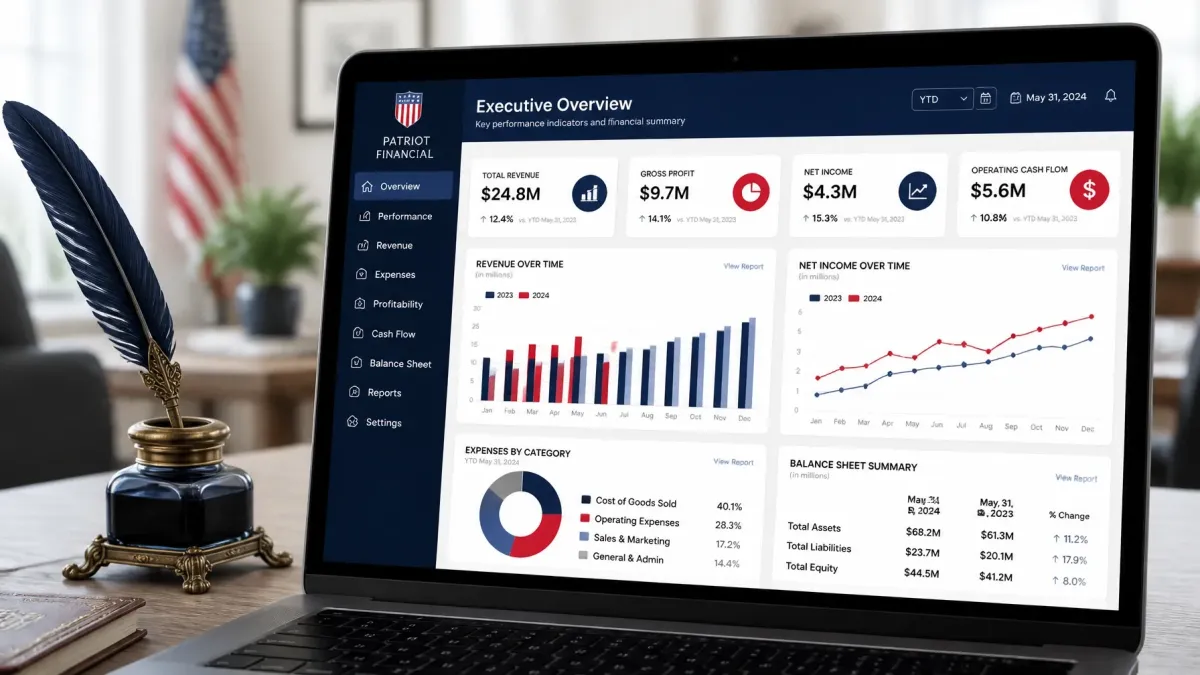
Built to Last : What Strong Business Finances Actually Look Like
Built to Last : What Strong Business Finances Actually Look Like

A business built to last doesn’t look the way most people expect from the outside.
When people see a "successful" business, they often point to the flashy things: a high-profile office, a fleet of branded vehicles, or a founder making a big splash on social media. But after 25 years of looking at the internal gears of thousands of companies, I can tell you that the exterior is often a poor indicator of structural integrity.
A business built to last doesn’t necessarily have the biggest revenue or the fastest growth. What it has is a financial foundation strong enough to support whatever gets built on top of it. That foundation is specific, observable, and buildable. It’s the difference between a business that’s merely surviving a lucky streak and one that is architected to withstand the decades.
In a month where we celebrate independence and the enduring legacy of the American spirit, I want to talk about what strong business finances actually look like: and how you can build them.
What Financial Strength is NOT
Before we can define what strength is, we have to clear away the myths. Most business owners measure their health by "snapshots," but snapshots can be incredibly deceiving.
1. It is not a high bank balance
I have seen businesses with $500,000 in the bank that were weeks away from insolvency because they had $600,000 in upcoming liabilities and no new revenue in the pipeline. Cash is vital, but a high bank balance can easily mask a deeply unprofitable business. It’s like having a full tank of gas in a car with a shattered frame; you can go for a while, but you’re not safe.
2. It is not strong revenue
Revenue is vanity. I say it all the time because it’s true. Revenue without margin is just expensive activity. If you’re doing $5 million a year but it costs you $5.1 million to deliver it, you don't have a business; you have a very stressful hobby. Financial strength is found in what you keep, not what you collect.
3. It is not "one good year"
One strong year doesn’t tell you whether the business is structurally sound. It tells you the market was favorable or you caught a trend. Real strength is demonstrated when the market turns, when a key employee leaves, or when a major client walks away. Strength is structural, not circumstantial.

The Five Markers of Strong Business Finances
So, if it’s not the bank balance or the top-line revenue, what is it? After two and a half decades in this industry, I’ve narrowed it down to five specific markers. If a business has these five things, it is built on stone. If it’s missing even one, it’s built on sand.
1. Clean, reconciled books maintained consistently
This is the baseline. We’re not talking about books that get "caught up" in February so you can file your taxes. We’re talking about books that are current every single month. They are reconciled to the bank statements, credit cards, and loan balances. There are no "unexplained" transactions sitting in a suspense account.
When your books are clean and consistent, you are operating from a place of truth. You aren't guessing at your numbers; you are reading them. This is why our cleanup services are so vital for businesses that have let things drift. You cannot build a skyscraper on a swamp. You have to clear the muck first. For many businesses, a professional cleanup: ranging from $997 to $3,500 depending on the complexity: is the first real investment they make in their long-term survival.
2. A Profit and Loss statement that tells the truth
A P&L that flatters the business is worse than no P&L at all. Strong business finances require a statement where revenue is recorded correctly, expenses are categorized accurately, and margins reflect what the business actually earns after all costs: including your real compensation as the owner.
If you aren't paying yourself a market-rate salary and the business is showing a profit, that profit is an illusion. A "true" P&L allows you to see exactly where your money is going and whether your business model is actually sustainable.
3. A Balance Sheet that accounts for everything
While the P&L tells you what happened over a period of time, the Balance Sheet tells you what the business is worth. Financial strength means having a balance sheet that accounts for every asset, every liability, and every obligation.
No missing EIDL loans. No unrecorded credit card balances. No phantom accounts receivable that you know will never be collected. A business with strong finances has a balance sheet that a lender, a buyer, or a partner could rely on without discovery of "hidden" debt later.
4. Cash flow visibility 90 days out
Knowing your bank balance today is basic. Knowing what your bank balance will be 90 days from now is financial strength.
This means understanding which months are historically slow, which fixed obligations (like insurance premiums or tax payments) are coming due, and what your accounts receivable pipeline looks like. Cash flow problems rarely "surprise" businesses that are watching. They surprise businesses that are operating in the dark. Visibility is the antidote to panic.

5. A quarterly conversation that translates numbers into decisions
This is the marker that separates the "okay" businesses from the "great" ones. Financial reports are only as valuable as the understanding they produce. A business with strong finances has a partner: a bookkeeper or advisor: who sits down with them every quarter to say: "Here is what your numbers are telling you, here is what it means for your goals, and here is what we need to do about it."
It’s not just a PDF delivered via email. It’s a conversation. It’s moving from broke to bankable by turning data into strategy.
What These Five Markers Make Possible
Why does all of this matter? It’s not just for the sake of being "organized." It’s about capacity. When you have a foundation of strong business finances, the entire world of opportunity opens up to you.
The Ability to Borrow: Banks don't lend to businesses with messy books. When you need capital to expand, your clean financials act as your resume.
The Ability to Partner: If an investor or a partner wants to buy into your vision, the first thing they will do is "open the hood." If the engine is clean, the deal moves forward. If it’s a mess, they walk.
The Ability to Hire: You can make hiring decisions with total confidence because you know exactly what your margins can support. You aren't "hoping" you can afford a new manager; you know you can.
The Ability to Weather the Storm: When a slow quarter hits, you don't panic. You saw it coming 90 days ago on your cash flow forecast, and you’ve already adjusted.
The Connection to Scale and Exit
Scale is often where businesses break. They grow their revenue, but because their financial systems were weak, the growth creates chaos. Suddenly, they are doing more work but have less cash. They are busier than ever but don't know if they are actually making money. Strong business finances are what make scale possible without the accompanying heart attack.
And then, there is the ultimate goal: the Exit.
Every business that gets sold at a premium multiple has one thing in common: three years of pristine, auditable financial records. If you ever want to sell what you’ve built, you aren't just selling your product or your customer list. You are selling a financial engine. If that engine has a history of clean records, you get paid for your hard work. If the records are a mess, the buyer will use that "risk" to slash your price or walk away entirely.

A Foundation Built to Last
My family has been building things in America since the 1600s. I have ancestors who crossed an ocean because they believed the opportunity was worth the risk. I have four ancestors who fought in the Revolutionary War to ensure that the things they built would belong to them and their children.
What that history has given me is a deep, bone-deep conviction: You don't build something real by hoping it works out.
You build it on a foundation strong enough to last. You build it with clean books that tell the truth. You build it with real margins that support a real life. You build it with a financial picture that holds up to the harshest scrutiny.
At Bookkeeping Made Simple, we don't just "do the books." We help you build that foundation. Whether you are starting from scratch or you need a major cleanup to get back on track, we are here to provide the clarity you need to lead.
Because at the end of the day, that’s not just bookkeeping. That’s your legacy. That’s what you leave behind.

Ready to build on a foundation that lasts? Let’s have the conversation nobody else is having.