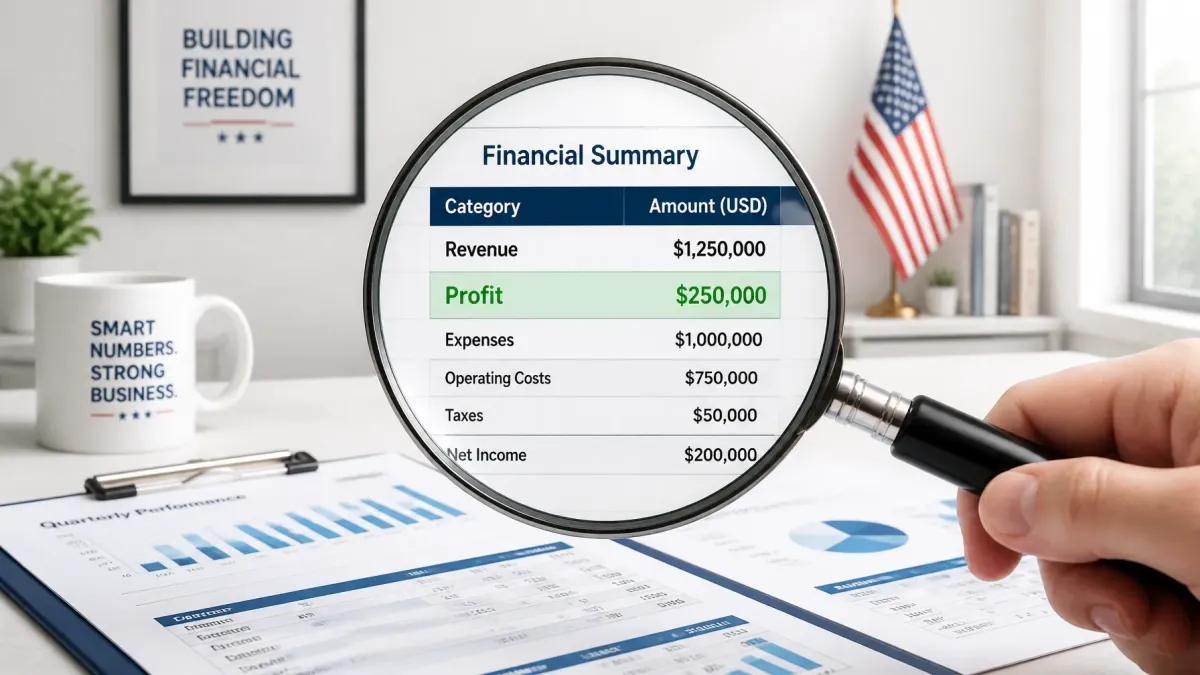
How to Know If Your Business Is Actually Profitable
How to Know If Your Business Is Actually Profitable

If someone stopped you right now and asked, "What was your net profit margin last month?" could you answer?
For most small business owners, the answer is a hesitant "I’d have to check my bank balance," or a quick call to an accountant they only speak to once a year. But here is the hard truth: your bank balance is a liar, and your revenue is just a vanity metric.
Revenue feels good. Seeing six or seven figures hit your accounts throughout the year feels like success. But revenue doesn't pay for your retirement, and it doesn't buy you a vacation. Profit does.
At Bookkeeping Made Simple, we see it every day: brilliant entrepreneurs who are incredibly busy, yet constantly feel like they’re running in place financially. They are generating massive revenue, but at the end of the month, they wonder where all the money went.
If you suspect you aren't making as much as you "should" be, or if you simply don't know the number, this guide is for you. We’re going to move you from financial fog to absolute clarity.
Revenue vs. Gross Profit vs. Net Profit: The Three Numbers You Must Master
To understand if you are profitable, you have to stop looking at "money in" as a single category. You need to break it down into three distinct layers.
1. Revenue (The Top Line)
This is the total amount of money your business brings in from sales before any expenses are taken out. It’s the "big number" people brag about at networking events. While revenue is necessary, it tells you nothing about the health of your business. You can have $1 million in revenue and be $100,000 in debt.
2. Gross Profit (The Middle Line)
This is your Revenue minus your Cost of Goods Sold (COGS). COGS includes the direct costs of producing your product or delivering your service, things like materials, direct labor for a specific project, or shipping.
Example: You sell a widget for $100. It costs you $40 to buy the materials and $10 to ship it. Your Gross Profit is $50.
Why it matters: If your Gross Profit is too low, you’ll never make enough to cover your overhead, no matter how much you sell.
3. Net Profit (The Bottom Line)
This is the holy grail. This is what is left after every single expense is paid, rent, software, insurance, taxes, and your own salary. This is the money that actually belongs to the business owner. When we talk about "business profitability bookkeeping," this is the number we are hunting for.

The Hidden Profit Killers: Expenses You’re Probably Undercounting
Most business owners aren't "unprofitable" because they’re spending money on lavish parties. They’re unprofitable because they’re suffering from a "thousand paper cuts." Here are the four biggest expenses that disappear when your books aren't clean:
The "Free" Owner’s Time
This is the most common mistake. If you don't pay yourself a market-rate salary and instead just "take what's left," your profit numbers are a fantasy. If you had to hire someone to do your job tomorrow, what would you have to pay them? That amount should be a line item in your expenses. If the business can't afford to pay you a fair wage and still show a profit, the business isn't actually profitable, it’s just a high-stress job you can’t quit.
Subscription Creep
That $15/month software you signed up for three years ago and never used? It’s still there. Along with the other twelve apps you forgot about. Small recurring costs are the silent killers of the small business profit margin. Without monthly bookkeeping to flag these, they can easily eat up 1–2% of your total margin.
The "Cost of Sales" Trap
Many service providers undercount the cost of delivering their work. They count the software they use, but they don't count the transaction fees from credit card processors (which can be 3% or more!) or the "little extras" they do for clients that aren't billed.
Interest and "Miscellaneous" Fees
Credit card interest, bank fees, and late payment penalties are often swept into a "miscellaneous" category. When your books are messy, these "oops" expenses can hide thousands of dollars in lost profit.
Knowing Your Floor: The Break-Even Calculation
How much do you need to bring in every month just to keep the lights on? Not to make a profit, just to not lose money. This is your Break-Even Point.
To find it, you need to separate your Fixed Costs (rent, core payroll, insurance) from your Variable Costs (materials, commissions).
The Formula:
Total Fixed Costs / (Gross Profit Margin %) = Break-Even Revenue.
If your fixed costs are $10,000 a month and your gross margin is 40%, you need $25,000 in revenue just to hit zero. If you’re bringing in $22,000, you’re losing $3,000 a month, even though you’re "doing great sales." Knowing your number gives you a target. Anything above that floor is where the real growth happens.

Are Your Clients Actually Losing You Money?
One of the most eye-opening exercises we do with our clients is analyzing Gross Margin by Service.
You might have a service that brings in $5,000 but costs $4,500 in labor and materials to deliver. Meanwhile, you have a smaller service that brings in $1,000 but only costs $100 to deliver.
The $5,000 client feels like the "big win," but they are actually eating your time and providing almost no profit to cover your overhead. When you have financial clarity, you can see which parts of your business are high-octane fuel and which ones are just dead weight. You might find that by cutting your "biggest" client, you actually become more profitable.
The Bank Balance Lie: Cash Flow vs. Profit
This is the hardest concept for many entrepreneurs to wrap their heads around: You can be profitable and still run out of cash.
Profit is an accounting calculation (Revenue - Expenses). Cash flow is the physical movement of money. If you finish a $50,000 project today, you might "earn" $20,000 in profit on paper. But if that client doesn't pay you for 60 days, you still have to pay your staff, your rent, and your taxes today.
Checking your bank balance tells you if you can pay your bills tomorrow. It does not tell you if your business model is sustainable. Only clean books can do that.
From Mystery to Dashboard: What Clean Books Make Possible
Most people think bookkeeping is about taxes. It’s not. Bookkeeping is about information.
When your books are current and accurate, profitability isn't a mystery you solve once a year with your CPA. It’s a dashboard you check every month. You can see:
Exactly where your money is going.
Whether your marketing spend is actually resulting in profitable sales.
If you have enough cash to hire that next employee.
If your books are currently a disaster, receipts in shoe-boxes, personal and business expenses mixed together, or months behind, you can't possibly know if you're making money. You’re just guessing.
If you’re behind, we can help. Our Cleanup Services are designed to take your messy records and turn them into a clear, auditable foundation. Whether you need a simple catch-up or a deep forensic dive, we offer transparent pricing to get you back on track:
Essential Cleanup: $997
Standard Cleanup: $1,997
Premium Comprehensive Cleanup: $3,500
Once you're clean, you can finally move from broke to bankable.

The Quarterly Review: The Conversation That Changes Everything
The most successful business owners we work with don't just look at their reports alone. They participate in a Quarterly Review.
This is a dedicated time to sit down with a professional and ask the hard questions: Why are our margins shrinking? Why is our labor cost increasing relative to revenue? What happens to our profit if we raise prices by 10%?
This conversation turns your data into a strategy. It moves you from being a "worker" in your business to being the CEO of your business. You stop making decisions based on "gut feelings" and start making them based on math.
You Built This Business to Make Money. Make Sure It Is.
You didn't start your business to work 60 hours a week for a "break-even" result. You started it to create wealth, freedom, and impact. But you can't manage what you don't measure.
Knowing your number is the first step to increasing it. If you’re tired of the "bank balance rollercoaster" and you're ready for real financial clarity, let’s talk.

Ready to find out what your numbers are actually telling you?
Book a free 20-minute Financial Clarity Call today. We’ll look at where you are, where you want to be, and how clean books can get you there.
Schedule Your Free Consultation at mysimplebookkeeping.com/contact