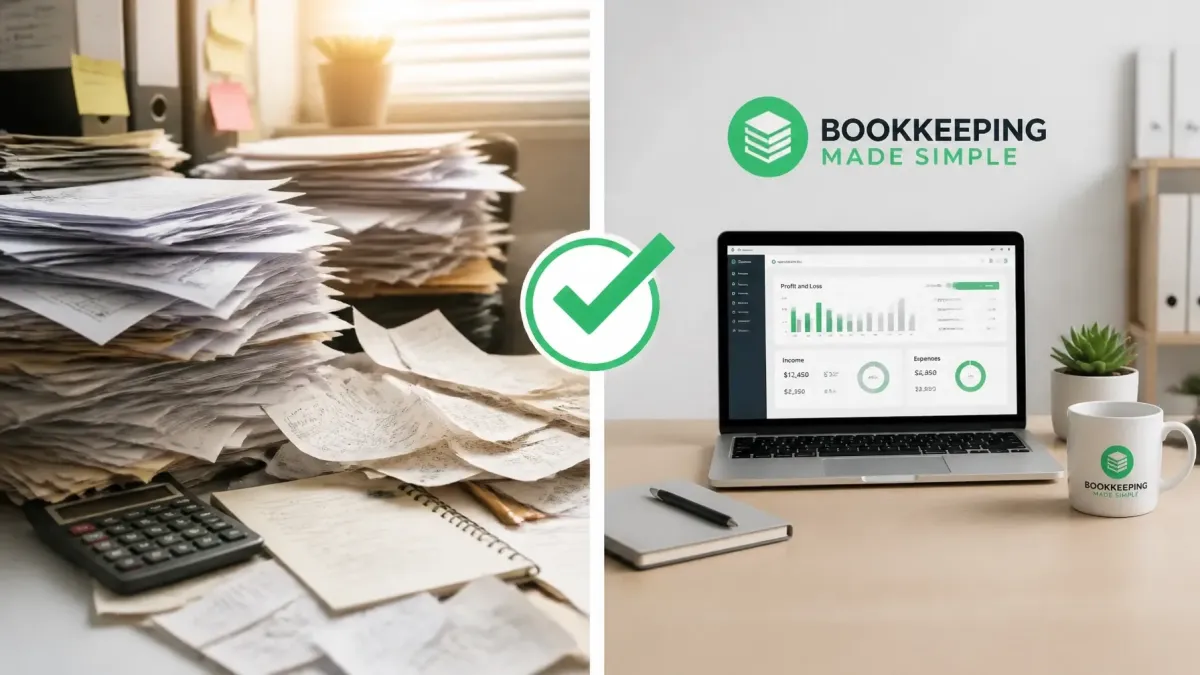
What Actually Clean Books Look Like
What Actually Clean Books Look Like

You log into QuickBooks. You see the green checkmark next to your bank account balance. It says the words you’ve been waiting to hear: Reconciled.
You breathe a sigh of relief. The bank matches the books. Everything must be fine, right?
Unfortunately, for thousands of small business owners, that green checkmark is a lie. Or, at the very least, it’s only half the truth. In the world of professional accounting, there is a massive, expensive difference between reconciled vs correct.
Most business owners have been told their books are "clean" simply because the bank balance matches the software balance. But if your categories are a mess, your loan payments are misapplied, and your personal Amazon habit is buried in "Office Supplies," your books aren't clean: they’re just balanced.
In this guide, we’re going to peel back the curtain on what genuinely clean books look like. We want to move you from the "green checkmark illusion" to true financial clarity, where your data is accurate, decision-ready, and tax-compliant.
The "Green Checkmark" Problem: Why Reconciled Isn't Enough
Reconciliation is simply the process of ensuring that every transaction that happened in your bank account is also recorded in your accounting software. It’s a math check. If the bank says you spent $100 at Staples, and your books say you spent $100 at Staples, you are reconciled.
But reconciliation doesn't care where you put that $100.
You could categorize a new laptop as "Travel Expenses." You could categorize a loan repayment as "Monthly Rent." You could even categorize a personal dinner as "Professional Services." The software will still give you that green checkmark because the dollar amounts match.
When books are "reconciled but incorrect," you end up with a Profit & Loss statement that is functionally useless. You might think you're more profitable than you are, or you might be missing out on thousands of dollars in tax deductions because your expenses are buried in the wrong places. This is why accurate bookkeeping is about more than just matching numbers: it’s about data integrity.

What Clean Books Actually Require
Genuinely clean books aren't just a list of transactions; they are a structural map of your business’s health. To achieve this, several layers of accuracy must exist simultaneously.
1. Correct Categorization
Every transaction must live in its "forever home." This means having a Chart of Accounts that actually reflects your business model. If you are a construction company, your "Cost of Goods Sold" should look very different from a digital marketing agency. Clean books ensure that "Meals & Entertainment" are kept separate (because they are taxed differently) and that "Owner’s Draws" aren't accidentally hiding in your "Payroll" category.
2. Proper Account Treatment
This is where most DIY bookkeeping falls apart. Not everything that leaves your bank account is an "expense." If you pay $2,000 toward a business loan, part of that is interest (an expense) and part is principal (a liability reduction). If you just code the whole thing to "Interest Expense," your Balance Sheet will show a loan balance that never goes down, and your Profit & Loss will be artificially depressed.
3. Accurate Tax Classification
Clean books are built with the end in mind: tax season. This means your bookkeeper is looking at transactions through the lens of the IRS. Are you tracking 1099 vendors? Are you separating non-deductible penalties from deductible fees? When your books are clean, your CPA doesn't have to spend ten hours "fixing" things in April: which saves you a fortune in accounting fees.
4. Zero Reconciliation Adjustments
If you see a transaction labeled "Reconciliation Adjustment" or "Opening Balance Equity" that hasn't been touched in months, your books are likely messy. These are "plug" numbers used to force the books to match the bank. Clean books don't need "plugs"; they need the truth.
The Four Pillars: Separating Reconciled from Correct
To help you evaluate your own financial standing, let's look at the four specific areas where bookkeeping cleanup is usually required.
Pillar 1: Categorization Strategy
In clean books, categories are consistent. If you pay for Adobe Creative Cloud, it shouldn't be under "Software" one month and "Dues & Subscriptions" the next. Inconsistency makes it impossible to compare month-over-month growth. Clean books provide a stable baseline so you can see exactly where your money is going.
Pillar 2: Balance Sheet Integrity
Most business owners only look at their Profit & Loss (P&L). But the Balance Sheet is where the "skeletons" live. Clean books have a Balance Sheet that matches reality. Your "Accounts Receivable" should only show money people actually owe you. Your "Security Deposits" should match your actual lease agreements. If your Balance Sheet is full of old, weird numbers, your P&L is likely wrong too.
Pillar 3: Tax-Ready Structure
Are your meals 50% deductible or 100%? Is that "equipment" an expense or an asset that needs to be depreciated? Clean books handle these questions in real-time. This prevents the "tax surprise" where you think you have $100k in the bank but find out you owe $40k in taxes because your "expenses" weren't actually deductible.
Pillar 4: The Absence of "Ask My Accountant"
We call the "Uncategorized Expenses" folder the "junk drawer" of bookkeeping. In clean books, that drawer is empty. Every dollar has a name and a purpose. If you have 50 transactions sitting in "Ask My Accountant," you don't have clean books: you have a pile of homework.

What Clean Books Make Possible
Why go through the effort of a bookkeeping cleanup? It's not just for the sake of being "tidy." Clean books are a powerful engine for business growth.
Financing and Loans: If you want to buy a building or get a line of credit, the bank is going to ask for your Balance Sheet. If it’s messy, they’ll see you as a high-risk borrower. Clean books get you approved faster and often with better rates.
Hiring Decisions: Can you afford a new Project Manager? If your books are clean, you can look at your "Net Profit" and "Cash Flow" and know the answer instantly. If they aren't, you're just guessing: and that's how businesses go under.
Strategic Planning: Clean books allow you to see trends. You can see that your "Cost of Goods" has risen 4% over the last three months, allowing you to adjust your pricing before it eats your profit.
Peace of Mind: There is a psychological weight to having "messy" books. When you know your numbers are accurate, that weight disappears. You can focus on your craft, your clients, and your family.
How to Evaluate Your Own Books: 4 Questions for Your Bookkeeper
If you aren't sure where you stand, ask your current bookkeeper (or yourself) these four questions:
"Can you show me the reconciliation reports for all bank and credit card accounts for last month?" (The balances should match the statements exactly.)
"Are there any transactions currently sitting in 'Uncategorized' or 'Suspense' accounts?" (The answer should be no.)
"Do our loan balances on the Balance Sheet match our actual lender statements?" (If they don't, your interest and principal are being miscalculated.)
"Are my personal expenses completely separated, or is there 'commingling' happening in the ledger?" (Clean books have a strict "no-personal-spending" rule.)
If the answers to these questions are "I don't know" or "We'll fix that at tax time," then your books are not clean.

What to Do If Your Books Aren't Clean
If you’ve realized that your "reconciled" books are actually a mess, don't panic. You aren't alone, and it’s not something to be ashamed of. Most entrepreneurs are experts at their business, not at accounting.
This is where a bookkeeping cleanup comes in. We specialize in taking the "green checkmark illusion" and turning it into a bulletproof financial foundation. We look back at your history, fix the categorizations, tie out your Balance Sheet, and hand you back a set of books you can actually trust.
Our Cleanup Options
We offer three levels of cleanup depending on how much "fixing" is required:
The Basic Polish ($997): Ideal for businesses that are mostly on track but need a professional eye to sweep through the last few months and ensure tax readiness.
The Standard Overhaul ($1,997): Our most popular option. This is for the business that has been "DIY-ing" it for a year and needs the structure rebuilt from the ground up.
The Deep Clean ($3,500): For businesses with multiple years of messy data, complex loans, or significant commingling issues that need a total forensic restoration.
Once your books are clean, the ongoing maintenance becomes a breeze. You’ll finally have the financial clarity you need to run your business with confidence.

Ready for Books You Can Actually Trust?
Don’t wait until tax season to find out your "reconciled" books were actually wrong. Whether you need a quick check-up or a total restoration, we’re here to help you move from overwhelmed to in control.
At Bookkeeping Made Simple, we provide the expert support you need to stop worrying about your books and start focusing on your growth.
Schedule your free consultation here : let’s look at your books together and see what "clean" really looks like for your business.