What Is Bookkeeping Cleanup and What Does It Cost
What Is Bookkeeping Cleanup and What Does It Cost

If your books are behind, messy, or just flat-out wrong, I want to start by telling you something important: You are not alone.
In fact, at Bookkeeping Made Simple, bookkeeping cleanup is one of the most common reasons business owners reach out to us. Whether you’ve been too busy growing your empire to log into QuickBooks, or you hired a "friend of a friend" who left your ledger in shambles, the feeling is usually the same: a mix of embarrassment, anxiety, and a looming fear of what the IRS might think.
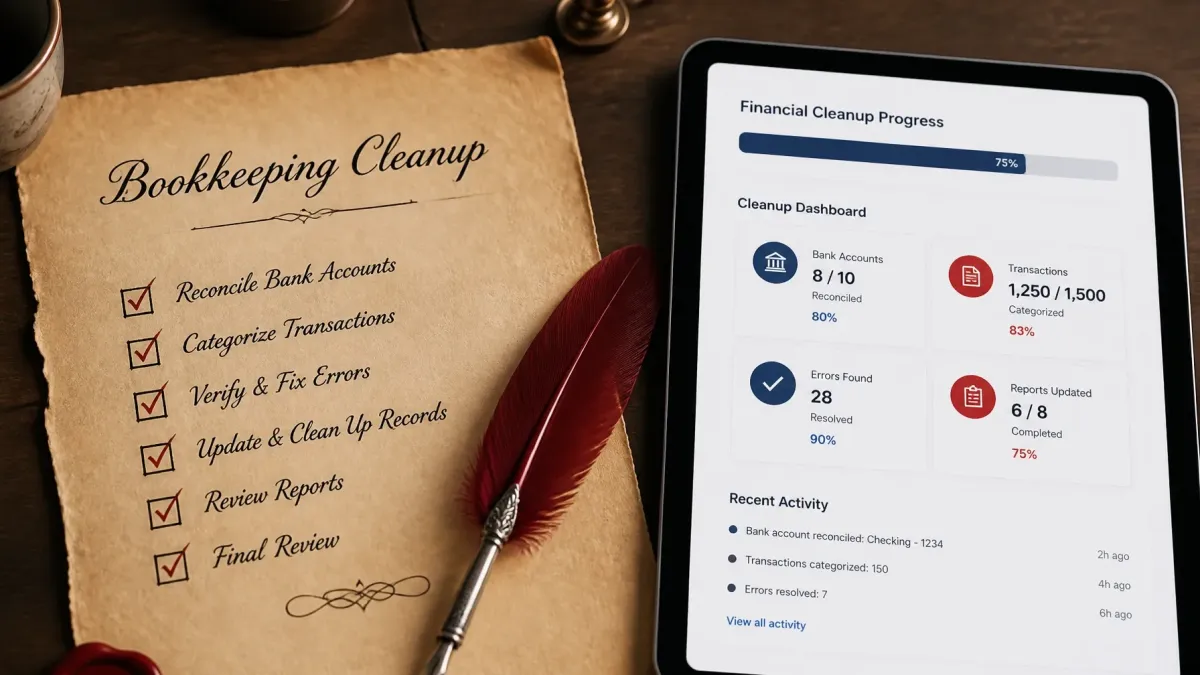
But here’s the truth: messy books are just a puzzle waiting to be solved. Bookkeeping cleanup is the process of bringing those financial records up to date and correcting errors so your books actually reflect the real history of your business. It is the bridge between "I think we're doing okay" and "I know exactly where every dollar went."
In this guide, we’re going to pull back the curtain on the cleanup process. We’ll look at what it actually involves, how long it takes, and, most importantly, what it realistically costs to go from chaos to clarity.
What Bookkeeping Cleanup Actually Is
To understand the cost, you first have to understand the work. Bookkeeping cleanup isn't the same as your ongoing monthly bookkeeping. Think of monthly bookkeeping like keeping your house clean, doing the dishes, sweeping the floors, and making the bed every day.
Cleanup is different. Cleanup is the deep-clean of a house that hasn't been touched in a year. It is reconstructive work on a period that has already passed.
The goal of a cleanup project is to take a specific window of time (usually a fiscal year or several months) and ensure that every single transaction is recorded, categorized correctly, and reconciled against your bank statements. When the project is finished, your Profit & Loss statement and your Balance Sheet are "source of truth" documents that you can hand to a CPA, a bank, or a potential buyer with total confidence.

When Do You Need a Cleanup?
Most business owners know instinctively when their books are a mess, but there are a few specific "red flags" that signal it’s time for a professional intervention:
The "Tax Season Scramble": Your tax preparer told you they can't use your records because nothing matches your bank statements.
The DIY Disaster: You tried to do it yourself in QuickBooks, but now there are hundreds of "uncategorized" transactions and your bank balance in the software is $50,000 off from reality.
The Ghost Bookkeeper: You had someone helping you, but they stopped responding, or you realized they were just "pushing buttons" without actually reconciling the accounts.
The Growth Spurt: Your business grew faster than your systems, and you haven't looked at a reconciliation report in six months.
Commingled Chaos: You’ve been using your personal credit card for business expenses (or vice versa), and you have no idea how to separate the two for the IRS.
The Cleanup Process: Step-by-Step
When we take on a cleanup project, we follow a rigorous, chronological process. We don't just guess; we verify. Here is what that looks like:
1. Initial File Review
Before we even touch a transaction, we perform a deep-dive file review. We look at your Chart of Accounts, your previous reconciliations, and your transaction volume. This allows us to see exactly how "deep" the mess goes so we can give you a firm price.
2. Gathering the "Source of Truth"
We collect bank statements, credit card statements, and loan documents for the entire period. These are our anchors. If it didn't happen in the bank, it didn't happen in the books.
3. Chronological Entry and Correction
We work from the oldest month forward. Why? Because errors compound. If January is wrong, February is wrong. We enter missing transactions and re-categorize existing ones to make sure they are in the right buckets for tax purposes.
4. Reconciling Period by Period
This is where the magic happens. We match your books to your bank statements down to the penny for every single month. This confirms that nothing is missing and nothing is doubled.
5. Balance Sheet Verification
We check your assets and liabilities. Do you really have that much cash? Is that loan balance correct? We ensure your Balance Sheet actually balances.
6. Final Delivery
Once the accounts are reconciled and the Chart of Accounts is cleaned up, we provide you with a clean set of financial reports. You are now from broke to bankable.

Why Chronology Matters in Cleanup
One of the biggest mistakes DIYers make is trying to fix "today" without fixing "yesterday."
In bookkeeping, your "Beginning Balance" for the month is just the "Ending Balance" from the previous month. If you have a $500 error in your January books, that error will haunt your reports for the rest of the year. That’s why we work from the start of the problem period forward, not backward from today. By building on a corrected foundation, we ensure that the final result is 100% accurate.
How Long Does It Take?
The timeline for a cleanup depends on two things: how far behind you are and how complex your business is.
1 Year of Straightforward Cleanup: Typically takes 1 to 3 weeks.
Multiple Years or High Volume: Can take 4 to 8 weeks.
A reputable bookkeeper will never promise a 24-hour turnaround on a year of messy books. Reconstructive work takes time and attention to detail. We provide a clear timeline estimate after our initial file review so you know exactly when to expect your clean reports.
What Does Bookkeeping Cleanup Cost?
This is the question every business owner asks, and rightfully so. Unlike monthly bookkeeping, which is a recurring fee, cleanup is almost always a fixed, one-time project fee.
At Bookkeeping Made Simple, we believe in transparent pricing. We don’t want you wondering if the clock is ticking every time we find an error. We assess the scope upfront and give you a flat rate.
Our cleanup engagements generally fall into three tiers:
Tier 1: The "Light Mess" – $997
This is for the business owner who is about one year behind, has a relatively low transaction volume, and has straightforward accounts. The books exist, but they haven't been reconciled, and things need to be tidied up for tax season.
Tier 2: The "Moderate Cleanup" – $1,997
This is our most common tier. It typically involves multiple years of books or a single year with high complexity, think multiple bank accounts, credit cards, and payroll. This requires significant re-categorization and a more detailed reconstruction of the financial history.
Tier 3: The "Heavy Reconstruction" – $3,500+
This is for the "disaster" files. If you have several years of missing data, forensic-level issues (like significant fraud concerns or massive commingling of funds), or highly complex entity structures, the price starts here. This involves deep forensic work to rebuild your financial history from scratch.
What Determines the Price?
Several factors can move the price up or down within these tiers:
Number of Accounts: Each bank account, credit card, and loan adds a layer of reconciliation.
Transaction Volume: Sorting through 50 transactions a month is very different from sorting through 500.
Availability of Documents: If we have to hunt down every bank statement ourselves, it takes longer.
State of the Data: Is the data already in QuickBooks but just wrong? Or are we starting with a shoe-box of receipts?

The ROI of Clean Books: The $8,000 Example
Many business owners view bookkeeping cleanup cost as a "sunk cost", money they are paying just to satisfy the IRS. But in reality, cleanup often pays for itself.
Take, for example, a client who came to us after two years of DIY bookkeeping. They thought they were doing "okay," but their books were a mess of uncategorized expenses. After our $1,997 cleanup project was complete, we identified over $8,000 in missed deductions that they hadn't realized were business-related.
Because their books were clean and categorized correctly, their CPA was able to slash their tax bill significantly. The cleanup didn't just give them peace of mind; it put thousands of dollars back in their pocket. This is what we mean when we talk about moving from broke to bankable.
What You Get at the End
When the cleanup is finished, you aren't just getting "done" books. You are getting:
A Complete Financial History: A reconciled Profit & Loss and Balance Sheet.
Tax Readiness: No more panicking when your CPA asks for reports.
Data You Can Use: You’ll finally know your actual margins, your true overhead, and your real profit.
A Clean Slate: A perfect starting point for ongoing monthly bookkeeping.
What Happens After Cleanup?
Cleanup is the foundation; monthly bookkeeping is the maintenance. Most of our cleanup clients transition directly into a monthly relationship. Now that the books are perfect, we keep them that way so you never have to pay for a "cleanup" ever again. You get 24/7 access to your data and the peace of mind that comes with knowing an expert has your back.
How to Get Started
The first step isn't a commitment; it's a conversation. We can't tell you exactly what your cleanup will cost until we see the state of the "house."
At Bookkeeping Made Simple, we offer a free file review as part of our initial consultation. We’ll look at your QuickBooks, identify the problem areas, and give you a firm, transparent quote.
Messy books are fixable. The relief of having clean, accurate records is worth considerably more than the cost of getting there.
Ready to find out what your cleanup would involve and what it would cost? Book a free 20-minute call with us today.