What Is Fractional CFO Services and Do You Need One
What Is Fractional CFO Services and Do You Need One

There is a specific moment in the life of every growing business when the questions change.
In the beginning, your questions are foundational: Are my receipts saved? Is my payroll processed? Are my bank accounts reconciled? These are essential, and having a great bookkeeper ensures they are answered with a "yes" every month.
But as you scale: perhaps you’ve crossed that $500,000 revenue mark or you’re staring down a major expansion: the questions get heavier. They stop being about what happened and start being about what will happen.
"Can I actually afford to hire three more people next month, or will that break my cash flow?"
"If I take on this massive new contract, will I actually make a profit after overhead, or am I just buying myself more work?"
"Why does my bank account look so low when my Profit & Loss statement says I’m making money?"
These aren't bookkeeping questions. They are strategic financial questions. Traditionally, these were the domain of a full-time Chief Financial Officer (CFO): an executive with a six-figure salary that most small businesses simply can't justify.
Enter the Fractional CFO.
In this guide, we’re going to break down exactly what fractional CFO services are, how they differ from your bookkeeper or CPA, and how to know if your business is ready for this level of partnership.
What a Fractional CFO Is: and What It Isn't
The term "CFO" can feel a bit corporate for a small business owner, but the function is vital. To understand what a fractional CFO does, it helps to distinguish them from the other financial professionals in your life.
1. The Bookkeeper (The Historian)
A bookkeeper’s primary job is to record what has already happened. They categorize transactions, reconcile accounts, and produce historical reports. They are the keepers of the data. Without them, you have no foundation.
2. The CPA (The Compliance Officer)
A CPA focuses primarily on tax compliance and high-level accounting. They ensure your filings are correct, help you minimize your tax liability, and represent you if the IRS comes knocking. They generally look at your business through the lens of a "tax year."
3. The Controller (The Manager)
In larger companies, a Controller manages the accounting department. They ensure the books are accurate and that financial systems are running efficiently.
4. The Fractional CFO (The Strategist)
A fractional CFO is a strategic financial partner who uses your historical data to help you make better future decisions. They are "fractional" because you hire them on a part-time or project basis, getting executive-level insight at a fraction of the cost of a full-time hire.
Think of it like this: your bookkeeper tells you where you’ve been; your CPA tells you what you owe the government; your fractional CFO tells you where you’re going and how to get there safely.

What Does a Fractional CFO Actually Do?
When you engage with a fractional CFO for your small business, you aren't just paying for more reports. You are paying for an advisor who sits on your side of the table. Their core responsibilities usually include:
Cash Flow Forecasting
This is the single most requested service. A bookkeeper tells you how much cash you had at the end of last month. A fractional CFO builds a model to tell you how much cash you will have in 30, 60, and 90 days. This allows you to plan for lean months or capitalize on growth opportunities without the stress of "guessing" your bank balance.
KPI Dashboards
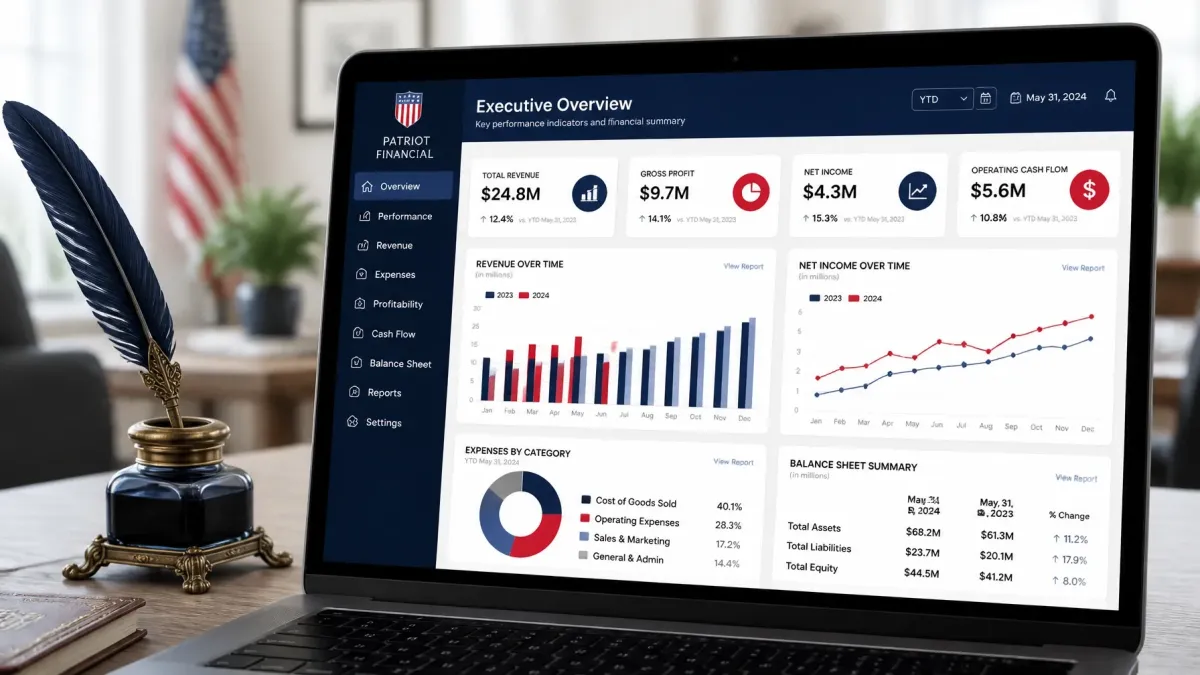
Most owners are drowning in data but starving for information. A fractional CFO identifies the 5 to 10 Key Performance Indicators (KPIs) that actually drive your business: things like gross margin per service line, customer acquisition cost, or revenue per employee: and puts them into a clear, visual dashboard.
Budget-to-Actual Analysis
Creating a budget is easy; sticking to it is hard. A CFO reviews your actual spending against your planned budget every month. If there’s a gap, they don't just point it out: they help you understand why it happened and how to adjust your operations to fix it.
Pricing and Margin Analysis
Are you actually making money? We often see businesses that are "busy" but broke because their pricing doesn't account for the true cost of delivery. A CFO performs deep-dive analysis to ensure every product or service you sell is contributing to your bottom line.
Hiring and Expansion Support
Before you sign a new lease or send out an offer letter, a CFO runs the numbers. They can show you exactly how a new hire will impact your profit margins and how long it will take for that person to "break even" for the company.
What a Fractional CFO Is Not Responsible For
It is a common mistake to hire a fractional CFO and expect them to "clean up the books."
A CFO’s value is built on the foundation of clean data. They do not do day-to-day bookkeeping, they do not process your payroll, and they typically do not file your tax returns.
If your books are messy, a CFO will spend 90% of their time fixing the data instead of analyzing it. This is an expensive way to handle bookkeeping. Before you hire a CFO, you must have reliable, up-to-date records. If you are behind or your numbers feel "off," you should start with a Bookkeeping Cleanup to get your foundation solid first. (At Bookkeeping Made Simple, our cleanup packages range from $997 to $3,500 depending on the complexity and how far back we need to go.)

How to Know If Your Business Is Ready
Not every business needs a CFO. If you are a solo practitioner with predictable expenses and steady income, your bookkeeper and CPA are likely all you need. However, you are likely ready for fractional CFO services if:
Revenue is above $500,000 and growing. As your revenue increases, the cost of a "bad decision" grows with it.
Decisions are getting harder. You’re no longer just buying a laptop; you’re considering a $50,000 equipment lease or hiring a management layer.
Cash flow feels like a roller coaster. You have plenty of work, but you’re constantly stressed about the timing of payments and bills.
You feel "blind" to your numbers. You have reports, but you don't know what they mean for your strategy next week.
You are planning an exit. If you want to sell your business in 2-3 years, you need to start managing your numbers now to maximize your Seller's Discretionary Earnings (SDE).
The Cost: Full-Time vs. Fractional
The math on hiring a fractional CFO is one of the easiest "ROI" calculations in business.
Full-Time CFO: A qualified CFO will cost you anywhere from $150,000 to $300,000 per year, plus benefits, payroll taxes, and bonuses. For most businesses under $10M in revenue, this is simply out of reach.
Fractional CFO: A fractional engagement typically ranges from $750 to $2,500 per month.
For most growing small businesses, the ROI on just one good financial decision: avoiding a bad hire, pricing a contract correctly, or managing a cash flow crunch effectively: will pay for the entire year of fractional CFO services.

How BMS Delivers Fractional CFO Services
At Bookkeeping Made Simple, we believe that strategy shouldn't be a separate department. It should be a seamless extension of your financial records.
We provide fractional CFO services as an advisory layer on top of our expert bookkeeping. This means we aren't just "outsourced consultants" who show up once a quarter; we are in your books every week.
Our approach includes:
Monthly/Weekly Bookkeeping: The essential foundation of clean data.
Quarterly Strategy Calls: Dedicated time to step away from the "doing" and look at the "planning."
KPI Dashboard Delivery: Real-time visibility into the numbers that matter.
Cash Flow Forecasting: Ensuring you always know what's coming around the corner.
Moving From Record-Keeping to Reality-Making
You don’t need a full-time executive sitting in an office down the hall to get executive-level financial results. You need a partner who understands the heritage of hard work that built your business and the modern tools required to scale it.
If you are tired of looking at your bank account and wondering what happened, it’s time to stop just "keeping books" and start "using numbers."
Ready to move beyond bookkeeping into real financial strategy?
Let’s talk about your goals and see if fractional CFO services are the right fit for your next stage of growth.
Schedule a free 20-minute Financial Clarity Call today.