What Is Seller's Discretionary Earnings and Why Does It Matter
What Is Seller's Discretionary Earnings and Why Does It Matter

You’ve spent years: perhaps decades: pouring your blood, sweat, and tears into your business. You’ve weathered economic downturns, navigated staffing crises, and built a brand that your community respects. But if a buyer walked into your office tomorrow and asked to see your books, do you know what they would actually pay for all that hard work?
Most small business owners have a "gut feeling" about what their company is worth. They look at their total revenue, their loyal client list, or the unique intellectual property they’ve developed. But here is the hard truth: Buyers don’t buy your gut feeling. They don’t even really buy your revenue. They buy your earnings.
Specifically, they look at one number that determines the fate of your exit: Seller’s Discretionary Earnings (SDE).
If you’ve never heard of SDE, you aren't alone. It is a term used by business brokers, M&A (Mergers and Acquisitions) professionals, and savvy investors to strip away the "noise" of your specific tax strategy and see the true heartbeat of the business.
In this guide, we’re going to pull back the curtain on SDE. We'll explore why it’s the most important number in your financial life and: more importantly: how the condition of your financial records today dictates the size of your check at the closing table.
What is Seller’s Discretionary Earnings (SDE)?
In the simplest terms, SDE is the total financial benefit that a single, full-time owner-operator derives from a business in a year.
When a buyer looks at your business, they are essentially asking one question: "If I step into your shoes tomorrow and run this business exactly as you do, how much money will I personally have in my pocket at the end of the year?"
Standard accounting profit (your Bottom Line) is designed for the IRS. It’s built to minimize your tax liability. SDE, however, is designed for the valuation. It "normalizes" the earnings to show the business's true earning potential before the owner starts making personal decisions about how to spend that money.

How to Calculate SDE: The "Add-Back" Strategy
The calculation of SDE starts with your Net Profit and then moves into a process called "adding back." We add back the expenses that are specific to you as the owner, but which a buyer wouldn't necessarily have to pay if they bought the business.
The standard formula for SDE is:
Net Profit + Owner’s Salary + Owner’s Benefits + Interest + Depreciation + Amortization + Non-recurring Expenses + Discretionary/Personal Expenses.
Let's break these down:
Net Profit: Your starting point from your Profit & Loss statement.
Owner’s Salary: Your W-2 wages and any bonuses you paid yourself.
Owner’s Benefits: Your health insurance, 401(k) matches, or life insurance paid by the company.
Interest & Depreciation: These are "non-cash" or financing-related expenses. A buyer might have a different loan structure or equipment strategy, so we add these back to show the business's raw performance.
Non-recurring Expenses: Did you have a one-time legal fee for a trademark? Did you buy a new roof for the warehouse? These aren't part of the daily operating costs, so they get added back.
Discretionary Expenses (The Perks): This is where it gets interesting. Do you run your car lease through the business? Do you pay for your family's cell phone plan or that annual "research trip" to Hawaii? These are "owner perks" that a buyer wouldn't have to spend to keep the doors open.
Why Add-Backs Matter So Much (The $240K Revelation)
To see the power of SDE, let’s look at a common scenario for a Main Street business owner.
Imagine an entrepreneur named Sarah. Sarah’s business looks like this on her tax return:
Revenue: $1,000,000
Net Profit: $80,000
On paper, Sarah’s business doesn't look like a goldmine. If a buyer used a simple 3x multiple on that $80,000 profit, the business would be valued at $240,000.
But wait. Sarah pays herself a $120,000 salary. She also runs about $40,000 in personal expenses through the business (her Tesla lease, her high-end health insurance, and some family travel).
When we calculate her Seller's Discretionary Earnings, the math changes completely:
Net Profit: $80,000
Owner Salary: +$120,000
Discretionary Perks: +$40,000
True SDE: $240,000
Suddenly, that $240,000 SDE: multiplied by that same 3x: gives us a valuation of $720,000.
By understanding SDE, Sarah has just "discovered" nearly half a million dollars in value that was hidden by her tax strategy. This is why having a money mindset that looks beyond just "paying less tax" is vital for wealth creation.

The Multiple: Why Your Books Determine the Price
Once you have your SDE, you apply a "multiple." Most Main Street businesses sell for between 2x and 4x their SDE.
If your SDE is $300,000, you might sell for $600,000 (2x) or $1.2 million (4x). That is a massive range. What determines where you land?
Industry stability.
Growth trajectory.
Systems and processes (can the business run without you?).
The quality and cleanliness of your books.
This last point is where most deals die. A buyer’s accountant is not going to take your word for it that the $40,000 in Sarah’s example was "personal." They are going to demand proof.
If your books are messy, the buyer starts to feel "deal fatigue." They lose trust. They start to wonder: "If Sarah can't accurately track her own salary, what else is hidden in these numbers?"
When trust drops, the multiple drops. Or worse, the buyer walks away.
Why Messy Books Destroy Your Wealth
Messy books are more than just an annoyance for your CPA; they are a direct threat to your retirement.
In a business sale, the burden of proof is on the seller. If you claim a $10,000 "add-back" for a one-time marketing consultant but you can't find the invoice or the ledger entry is tagged as "General Expenses," the buyer's accountant will reject it.
Let’s do the math on a rejected add-back:
If you have $50,000 in valid add-backs that are rejected because your financial records are a disaster, and your business is selling at a 3x multiple, you just lost $150,000 at the closing table.
Clean books aren't just about compliance. They are a wealth preservation strategy.
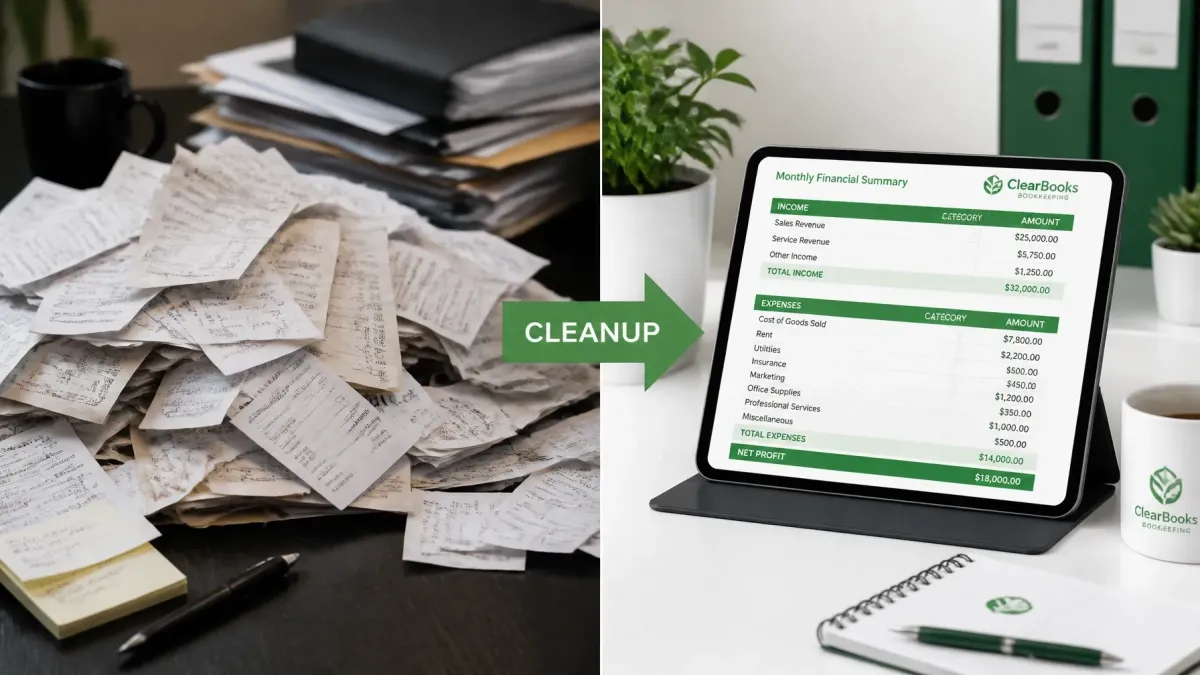
If your books are currently a "shoebox full of receipts" situation, you need a professional intervention before you even think about listing your business. We offer specialized cleanup services to get your historical data in order:
The Basic Cleanup ($997): Perfect for small setups that just need a seasonal refresh.
The Deep Dive ($1,997): For businesses with a year or more of catch-up work needed.
The Total Overhaul (starting at $3,500): For established businesses with complex, messy histories that need to be made "buyer-ready."

Exit Prep Starts Now (Not When You're Tired)
The biggest mistake business owners make is waiting until they are "burnt out" to start thinking about SDE.
A sophisticated buyer: or an SBA lender: will want to see three years of clean, documented, and auditable financials. They want to see a trend, not just one "good year."
If you are three years away from wanting to retire or move on to your next venture, you needed to start cleaning your books yesterday. You need to stop "hiding" profit and start "documenting" SDE.
This process often moves you from broke to bankable, turning a job you own into an asset you can sell. Your books are the story of your business's success. If the story is written in messy handwriting on stained napkins, no one is going to buy it.
Your Books Are What You Sell
When you sell your business, you aren't just selling your equipment or your customer list. You are selling your financial history.
At Bookkeeping Made Simple, we help entrepreneurs stop worrying about the "how" of bookkeeping so they can focus on the "why": building a business that is valuable enough to provide them with the freedom they deserve.
Whether you're looking for ongoing support to keep your SDE high or you need an emergency cleanup to save a deal, we're here to help.
Thinking about an exit in the next 3–5 years?
Don't leave your valuation to chance. Let's make sure your books are telling the right story: a story of profit, stability, and value.
Schedule your free 20-minute consultation today to get started.