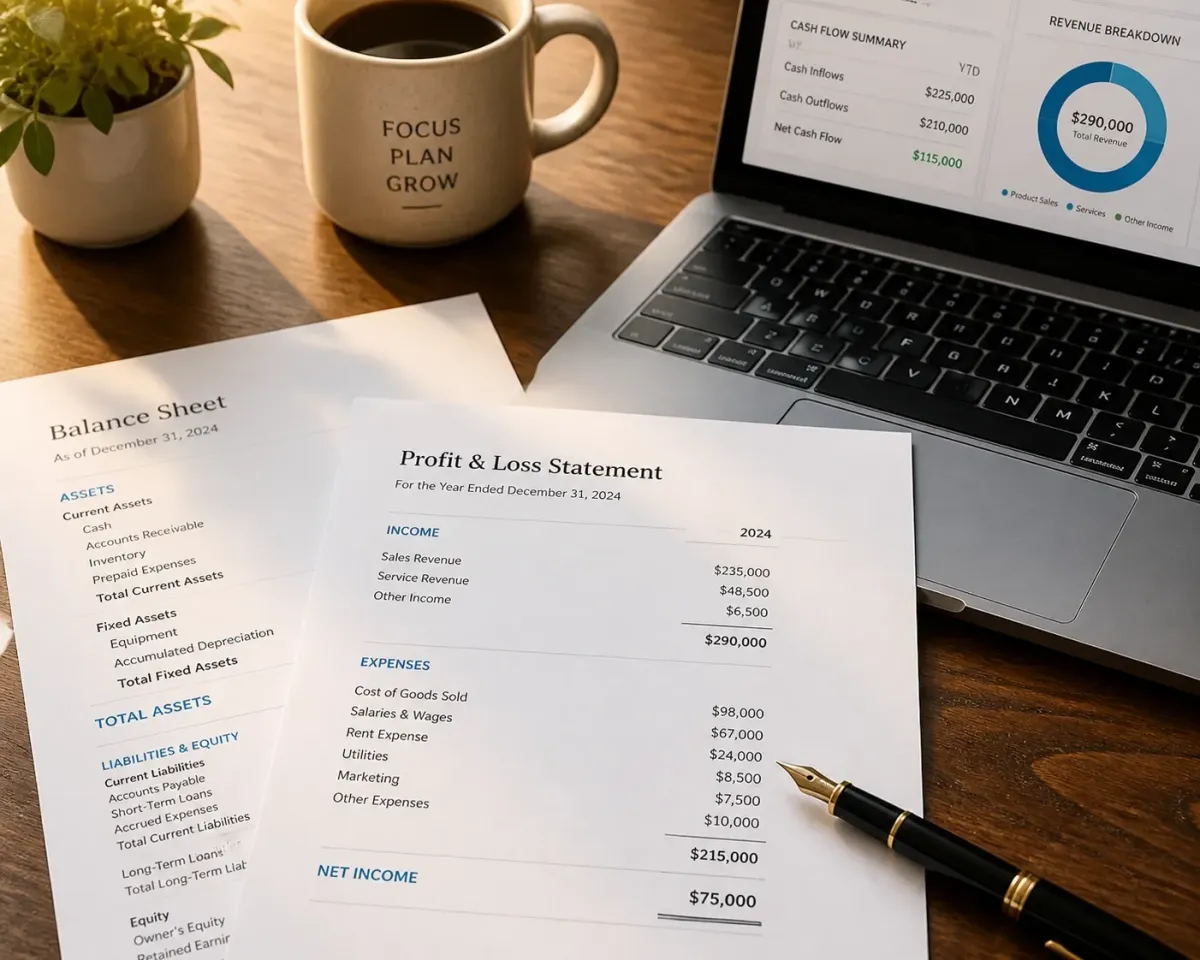
What Reconciliation Actually Means : And Why It's Not a Button You Push
What Reconciliation Actually Means : And Why It's Not a Button You Push

If you have ever opened your accounting software, clicked Reconcile, and assumed the job was finished, you are not alone.
Many small business owners understandably believe reconciliation is an automated task. The software connects to the bank, imports transactions, matches a few entries, and produces a green checkmark. It looks complete.
But a green checkmark is not the same thing as reliable books.
So, what is bank reconciliation for a small business? In plain English, it is the process of comparing your business records to the actual bank statement, investigating every difference, and making sure the final balance reflects reality.
The software can help organize the information. It cannot replace the investigation.
That distinction matters all year: but especially as Q4 approaches. A P&L is an output, not the work. The quality of that output depends on what happened before the report was created.

What reconciliation actually verifies
A bank reconciliation compares two records of the same cash activity:
Your accounting records, such as your general ledger or bookkeeping software
The bank’s official statement for the same account and period
The goal is not simply to make two numbers match. The goal is to understand why they match: or why they do not.
A proper reconciliation asks questions such as:
Did every deposit recorded in the books reach the bank?
Did every withdrawal on the bank statement get recorded?
Was anything entered twice?
Was a transaction recorded for the wrong amount?
Were bank fees, interest, or automatic payments missed?
Were owner draws, loan payments, or equipment purchases categorized correctly?
Does the balance sheet reflect what the business actually owns and owes?
When reconciliation is complete, every difference should fall into one of two categories:
A legitimate timing difference, such as an outstanding check or deposit in transit
An identified error or missing entry that has been corrected or properly documented
The adjusted book balance and adjusted bank balance should agree.
That is the proof.
Why reconciliation is an investigation: not a button
Accounting software is very good at finding patterns. It may recognize that a recurring $500 payment looks like the same vendor expense as last month. It may suggest a match between a deposit and an invoice.
Those suggestions can save time. But software does not know the full story behind every transaction.
For example, a $20,000 payment might be:
A regular operating expense
A loan payment that needs to be divided between principal and interest
A distribution to an owner
The purchase of equipment
A transfer between business accounts
The bank feed shows that money moved. It does not explain the accounting treatment.
That is why the bookkeeping reconciliation process requires human review. Someone must look at the supporting details, understand the transaction, and determine whether it belongs in the right account.
Reconciliation is not just matching. It is verification.
What a real reconciliation can find
1. Duplicate entries
Duplicate transactions are common, particularly when a business uses both imported bank feeds and manual entries.
For example, a business owner may manually enter a check payment and later accept the same transaction from the bank feed. The books now show the expense twice, even though the bank account only decreased once.
That can lead to:
Expenses being overstated
Net income being understated
Cash activity appearing inconsistent
Vendor balances becoming unreliable
When transactions are matched one by one, an entry with no corresponding bank transaction stands out. The duplicate can then be removed or corrected.
2. Missing transactions
A bank statement may include transactions that never made it into the accounting records.
Common examples include:
Monthly bank fees
Credit card payments
Automatic loan withdrawals
Interest income
Returned customer payments
Electronic transfers
Recurring software subscriptions
If those items are missing, your books may show more cash than you actually have: or fail to show an expense that affects profitability.
The reverse can also happen. A transaction may appear in your books but never clear the bank. If enough time has passed, that may indicate a payment was entered but never made, a deposit was recorded incorrectly, or an old item needs investigation.
3. Bank errors or unauthorized activity
Banks are generally accurate, but errors can happen. A transaction may be posted for the wrong amount, duplicated, charged to the wrong account, or appear without authorization.
A reconciliation gives you a structured way to identify those issues. If a bank statement item cannot be connected to a legitimate business transaction, it should not simply be ignored.
You may need to review receipts, payment confirmations, check images, or account activity before contacting the bank. Prompt investigation is especially important for unauthorized transactions because reporting deadlines may apply.
4. Miscategorized transactions
A transaction can be recorded in the correct amount and still be recorded incorrectly.
Examples include:
Equipment recorded as office supplies
An owner draw recorded as a business expense
A loan payment recorded entirely as interest
A personal transaction recorded as a business purchase
A customer deposit recorded as revenue before it was earned
These errors can distort both the P&L and the balance sheet.
For Q4 planning, this matters because business owners need to know more than how much money moved. They need to know what the money represented.
5. Accumulated balance-sheet errors
Some bookkeeping errors do not immediately appear on the P&L. They accumulate quietly on the balance sheet.
For example, an old unreconciled balance may remain in:
Accounts receivable
Accounts payable
Loans
Credit cards
Undeposited funds
Owner equity
Fixed assets
A business can continue receiving monthly P&Ls while these accounts become less and less reliable.
That is why reconciling the bank account is not merely a cash exercise. It is part of verifying the financial structure underneath the reports.
What the process looks like in practice
A thorough reconciliation generally follows these steps:
Step 1: Use the correct statement period
The bookkeeper begins with the bank statement’s beginning and ending dates and balances. The accounting records must be reviewed for the same period.
Comparing mismatched dates can create false discrepancies and make the review harder than it needs to be.
Step 2: Match deposits
Each deposit in the books is compared with the bank statement. The review looks for deposits in transit, duplicate deposits, missing deposits, and deposits recorded for the wrong amount.
Step 3: Match withdrawals and payments
Checks, debit card transactions, electronic payments, credit card payments, and transfers are reviewed against the bank activity.
Uncleared items may be legitimate timing differences: but they should not remain unexplained indefinitely.
Step 4: Record bank-only activity
Fees, interest, automatic withdrawals, returned payments, and similar items may need to be entered into the books.
Step 5: Investigate discrepancies
This is where the real work happens. Every unresolved difference is researched using receipts, invoices, payment records, loan statements, or other documentation.
Step 6: Correct the accounting records
Once the cause is known, the transaction can be corrected, reclassified, added, removed, or documented as a legitimate timing difference.
Step 7: Review the final financial statements
The reconciliation should support a balance sheet and P&L that make sense together. The cash balance should be supportable, and unusual balances should have an explanation.
Why an unreconciled P&L is output without verification
Your accounting software can generate a P&L whether or not the underlying accounts have been reviewed.
That report may look polished. It may include charts, percentages, and month-by-month comparisons. But the existence of a report does not prove that the information inside it is accurate.
An unreconciled P&L may be affected by:
Duplicate expenses
Missing income
Incorrect loan entries
Personal expenses categorized as business expenses
Transfers treated as revenue
Equipment recorded as a regular expense
Transactions posted to the wrong period
The report is still an output. Reconciliation is part of the work that gives you a reason to trust it.
As Donna Harris, MBA, MAcc, and CEO of Bookkeeping Made Simple, I often remind business owners that financial clarity is not a dashboard feature. It is the result of accurate, consistent work performed behind the dashboard.

Why this matters before Q4
Q4 decisions are easier when your financial information is current and reliable.
You may need to evaluate:
Whether cash flow can support a new hire
Whether pricing is producing a healthy margin
Whether a year-end distribution is prudent
Whether an equipment purchase makes sense
Whether accounts receivable is creating a cash shortage
Whether your year-to-date profit is higher or lower than expected
None of those decisions should be based on assumptions: or on a P&L that has never been verified.
If your books are current but you are not sure they are right, our ongoing bookkeeping services can provide consistent reconciliation and review.
If your accounts have been behind or unreliable, bookkeeping cleanup may be the better starting point. Bookkeeping Made Simple offers cleanup engagements priced at $997, $1,997, or $3,500, depending on the scope of the work required.
The goal is not to make your software look complete. The goal is to produce financial statements you can use.
Reconciliation gives you a foundation for decisions
Reconciliation may happen inside bookkeeping software, but it is not performed by clicking a button.
It is the process of checking the story your books are telling against the evidence in your bank statements. It finds duplicate entries, missing transactions, bank errors, miscategorized items, and balance-sheet problems that can otherwise remain hidden.
Most importantly, it turns financial reporting from an assumption into something supportable.
Before Q4 begins, take a close look at your books. Do you know the cash balance is right? Do you know the balance sheet has been reviewed? Do you know the P&L reflects what actually happened in the business?
If the answer is uncertain, you do not need to feel embarrassed or overwhelmed. You need a clear next step.
Book a Financial Clarity Call with Bookkeeping Made Simple, and let’s determine what your books need to become reliable before Q4 decisions arrive.