Why a Few Negative Reviews Shouldn't Stop You From Hiring a Business , And What to Actually Look For
Why a Few Negative Reviews Shouldn't Stop You From Hiring a Business , And What to Actually Look For

You’re scrolling through Google Maps or Yelp, looking for a service provider. Maybe it’s a plumber, a marketing agency, or a new bookkeeper. You see two options.
Option A has a flawless 5.0-star rating with 45 reviews. Option B has a 4.2-star rating with 120 reviews, including a few angry 1-star rants about "long wait times" or "communication issues."
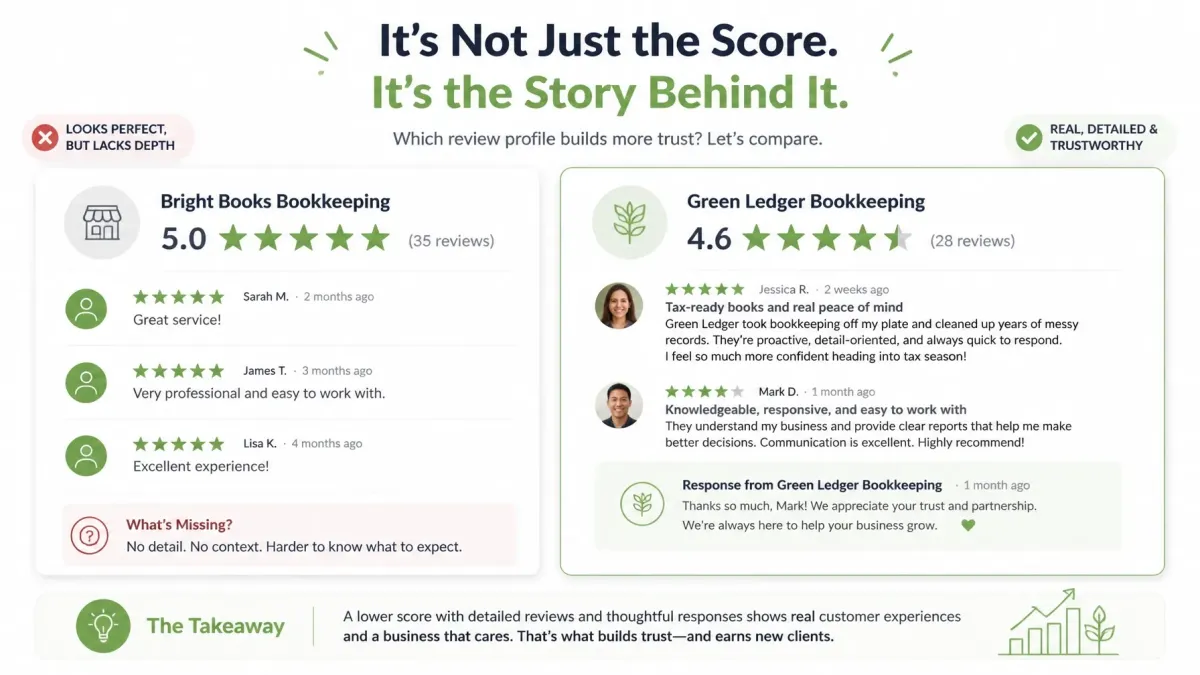
If you’re like most people, your finger instinctively hovers over Option A. We’ve been conditioned to believe that "5.0" equals "Perfect" and anything less equals "Risky." But here is the contrarian truth that most marketing "gurus" won't tell you: A perfect 5.0 rating is often a red flag, not a green light.
When you filter out a great business just because they had a 4.2 instead of a 5.0, you might be missing out on the most established, honest, and capable partner for your business. In this guide, we’re going to look past the stars and teach you how to evaluate Google reviews for a small business like a pro.
Why Perfect Ratings Are Often Suspicious
In a world where humans are involved, "perfect" is rarely authentic. If a business has been operating for more than a year and has more than 20 clients, the statistical likelihood of having zero dissatisfied customers is nearly non-existent.
When you see a wall of flawless 5-star reviews, one of four things is usually happening:
Review Gating: The business uses software that "asks" the customer how they felt first. If the customer says "Great!", they get a link to Google. If they say "Bad," they get a private feedback form that never sees the light of day. This is actually a violation of Google's terms of service, yet it’s rampant.
The "Friends and Family" Special: The business is new and has reached out to every cousin, former coworker, and high school friend to "leave a quick 5-star." These reviews lack substance and don't reflect actual client experiences.
Review Manipulation: In more extreme cases, businesses buy fake reviews. You can usually spot these by the generic language ("Very good service!") and profiles that have only ever reviewed one business.
Low Volume: They might be great, but they’ve only served five people. A 5.0 with 5 reviews tells you very little about how that business handles scale, stress, or complex problems.

What a Healthy Review Profile Actually Looks Like
When we look for partners at Bookkeeping Made Simple, or when clients look for us, we look for a healthy profile. A healthy profile is "noisy." It has variety. It looks like real life.
A trustworthy business profile usually has:
A "High-Four" Rating: Usually between 4.3 and 4.8. This shows the business is excellent but also that they are busy and serve a wide range of people.
A Spread of Ratings: You want to see mostly 5s, several 4s, and even the occasional 1 or 2.
Recent Activity: A business with 50 reviews from 2018 but nothing in 2026 is a red flag. It suggests they’ve stopped caring about their reputation or, worse, they’re no longer in business.
Specific Details: Real customers use names. They mention specific problems. They might say, "Donna helped me find a $2,000 error in my payroll," rather than "Best bookkeeper ever!"
How to Read Negative Reviews (The Signal vs. The Noise)
Not all negative reviews are created equal. When you see a 1-star or 2-star review, don't close the tab. Instead, read it critically. You are looking for the difference between an outlier and a pattern.
The "Karen" Outlier
We’ve all seen them. The reviewer who is angry about something the business couldn't control. "I showed up at 5:01 PM and they were closed! Unprofessional!" This tells you more about the reviewer than the business. If the complaint is purely emotional or based on a personal grudge, ignore it.
The Specific Service Failure
"I hired them for a bookkeeping cleanup and it took three weeks longer than promised." This is a real complaint. If you see this once in 50 reviews, it’s an outlier. Everyone has a bad week or a project that goes sideways. If you see it five times, it’s a systemic failure. That’s a pattern you should worry about.
The "Wrong Fit" Complaint
Sometimes people leave bad reviews because they bought the wrong thing. If a small business owner hires a high-end firm but expects "budget" prices, they’ll be unhappy. Read the review to see if the customer’s expectations were realistic.
The Fake, Mistaken, or Unverifiable Review Problem
There’s another issue most people don’t think about: Google does not verify that every reviewer was actually a paying client. In practice, that means any account can leave a review.
Sometimes negative reviews come from people who never hired the business at all. Sometimes they confused the company with a competitor. Other times, the review is driven by a personal grievance that has nothing to do with the actual service.
That doesn’t mean every negative review is fake. It does mean you should read carefully before assuming the worst. One of the strongest signals is the business owner’s response. If the owner calmly says they cannot locate the reviewer in their client records, cannot match the name to any project, or have no record of providing service to that person, that is an important clue the review may be illegitimate.
In other words, don’t just read the complaint. Read the response right beside it. A thoughtful owner reply that says, in professional language, "We’re unable to find you in our client records and would like more information," can tell you a lot.
The Response Matters More Than the Review
This is the most important part of how to evaluate Google reviews. If you see a negative review, look for the owner’s response.
A professional, calm, and solution-oriented response is a massive green flag. It tells you that if you have a problem, the business will acknowledge it and try to fix it.
What to look for in a professional response:
Promptness: Did they reply within a few days?
Accountability: Did they apologize for the experience (without necessarily admitting legal fault)?
Professionalism: Did they stay calm, or did they get defensive and start arguing?
The "Take it Offline" Move: A great business will say, "We’d love to make this right. Please call us at the office so we can discuss the details."
If a business ignores their negative reviews, it suggests they don't value feedback. If they attack the reviewer, run the other way.

The Ratio Rule: Understanding Statistical Reality
In the world of service businesses: especially something as personal and complex as bookkeeping and accounting: you cannot please everyone 100% of the time.
Think of it as the Ratio Rule. If a business has 20 reviews and 2 are negative, that’s a 10% dissatisfaction rate. In the real world, 10% of people are either having a bad day, have mismatched expectations, or are simply impossible to please.
If the other 18 reviews (90%) are glowing and describe a consistent, positive experience, the business is likely top-tier. Don’t let a 10% statistical reality scare you away from a 90% success rate.
Red Flags That Actually Matter
While we're telling you not to fear a few bad reviews, there are red flags that should stop you in your tracks.
Silence: As mentioned, zero responses to reviews (positive or negative) shows a lack of engagement.
Identical Failures: If three different people in the last three months all say "They lost my documents" or "They didn't file my taxes on time," believe them. That is a broken process, not a one-time mistake.
Dishonesty or Fraud: Any review that credibly describes unethical behavior, hidden fees, or "ghosting" after payment should be taken very seriously.
The Review Burst: If a business goes from 10 reviews to 60 reviews in a single week, and they all look generic, they likely bought a "review pack." This is review manipulation and is a major breach of trust.
What to Look for in a Bookkeeper Specifically
Choosing someone to handle your money is different from choosing a place to get a taco. When evaluating a financial professional, the "Review Filter" should be even more sophisticated.
You want a bookkeeper who is:
Consistent: Look for reviews spanning several years.
Knowledgeable: Look for keywords like "tax savings," "clear reports," or "peace of mind."
Responsive: If reviewers say "They always answer my calls," that’s gold in the accounting world.
At Bookkeeping Made Simple, we know that our reputation is built on the daily wins we provide for our clients. Whether we're doing a complex cleanup for messy books (starting at $997) or managing monthly payroll and accounting, our goal is to provide a 5-star experience, even if we’re human enough to admit that every business journey has its bumps.

The Bottom Line: Trust Your Gut, Not Just the Stars
The next time you see a 4.2-star business, don't keep scrolling. Click on it. Read the 4-star reviews (these are often the most honest). Look at how the owner handles the 1-star "outliers."
A business that is transparent about its feedback: even the messy bits: is a business that operates with integrity. They aren't trying to hide behind a curated, fake image. They are showing up, doing the work, and dealing with the reality of serving real people.
When you're ready to work with a bookkeeper you can trust: one who values accuracy and transparency above all else: let's talk. We don't just "do your books"; we provide the financial clarity you need to grow your business without the stress.
Schedule a free consultation at Bookkeeping Made Simple today. Let’s look at your books together and see how we can get you moving in the right direction.